

By:
Todd McPadden
Product Sales Leader, High Pressure Transducers
Published on:
September 14th, 2026
Topics:
Subscribe now and get the latest blog posts delivered straight to your inbox.
By:
Todd McPadden
Product Sales Leader, High Pressure Transducers
Published on:
September 14th, 2026
Topics:
.png?width=1600&height=534&name=Choosing%20Pressure%20Sensor%20for%20OHV_BLOG%20(1).png)
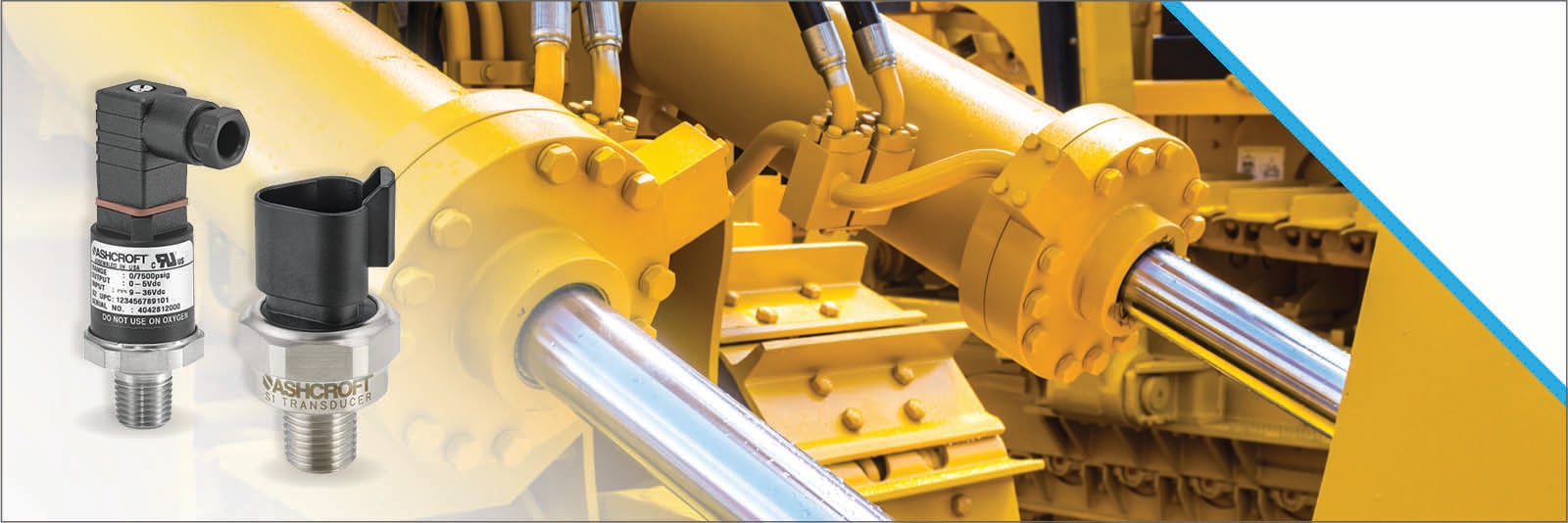
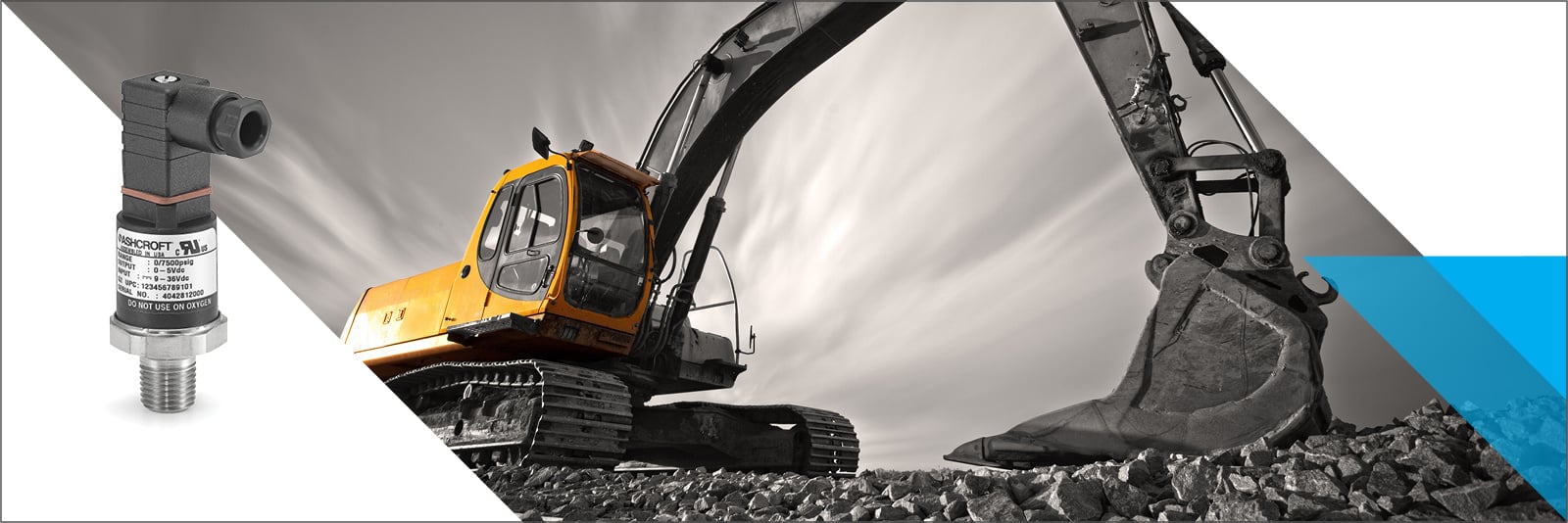
Pressure sensors used in off-highway vehicles (OHV) and mobile equipment must endure continuous vibration, mechanical shock, changing temperatures, dirt, water, and demanding hydraulic conditions for extended periods. Choosing the right sensor means looking beyond pressure range to consider how the instrument will perform in the actual vehicle environment.
With decades of experience developing pressure sensing technology, Ashcroft and its parent company, Nagano Keiki Co., Ltd., bring extensive expertise in pressure measurement for OEM and industrial applications. The different types of pressure transducers engineered by Ashcroft provide useful examples of how specifications can vary based on the application.
Read this article to learn how to evaluate shock and vibration resistance, ingress protection, pressure range, and electrical connections when selecting a pressure sensor for off-highway and mobile equipment.
What makes off-highway equipment harder on a pressure sensor?
Unlike a stationary process line, equipment applications, mobile equipment such as excavators, wheel loaders, combines, skid steers, and mining haul trucks can expose pressure sensors to several stresses at the same time. Examples include:
- Continuous vibration: Engines, drivetrains, hydraulic systems, and travel across uneven terrain can transmit vibration through the vehicle and into the sensor.
- Hydraulic pressure spikes: Cylinder movement and valve shifts can create rapid pressure changes that repeatedly stress the sensing element.
- Temperature extremes: Equipment may operate in direct summer heat, freezing winter conditions, or environments where temperatures change considerably during operation.
- Dirt and water exposure: Dust, mud, standing water, and equipment washdown can challenge both the sensor housing and its electrical connection.
- Electrical interference: Alternators, variable frequency drives(VFDs), and other vehicle systems can introduce electromagnetic interference (noise) that should be considered when selecting the sensor and connection.
Because these stresses can occur together, off-highway OEMs may evaluate sensors using recognized heavy-duty vehicle test practices such as SAE J1455 rather than relying only on general industrial specifications.
How much shock and vibration resistance do you need?
Shock and vibration describe different types of mechanical stress, so it is important to evaluate both specifications.
What is shock?
Shock is a short, high-magnitude event, such as a wheel dropping into a pothole or a bucket striking a rock. Sensor specifications typically express shock as a peak g-force over a defined duration and waveform.
What is vibration?
Vibration is continuous, lower-magnitude energy generated by sources such as the engine, hydraulic system, and movement across uneven terrain. It is typically expressed as a g-force across a specified frequency range.
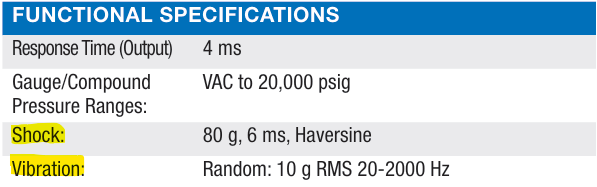
For example, the Ashcroft® G2 Pressure Transducer is rated for 100 g over 6 milliseconds in a haversine waveform for shock and 20 g RMS across 20 to 20,000 Hz for vibration.
When comparing sensors, look at both specifications rather than relying on a general description such as “rugged.” The two ratings tell you different things about how the sensor is designed to perform in a mobile environment.
Figure 1: G2 shock and vibration specs
What ingress protection rating fits a field or jobsite environment?
The right ingress protection (IP) rating depends on how much dust, water, and washdown exposure the sensor will encounter. Off-highway equipment can experience several of these conditions in the same workday.
Some common ratings include:
- IP65: Provides dust-tight protection and protection against water jets.
- IP66: Also provides dust-tight protection, with protection against powerful water jets.
- IP67: Adds protection against temporary immersion and may be appropriate for sensors installed where they could encounter standing water or mud.
- IP69K: Withstands close-range, high-energy water jets up to 80 °C at pressures up to 100 bar encountered in heavy duty wash down applications.
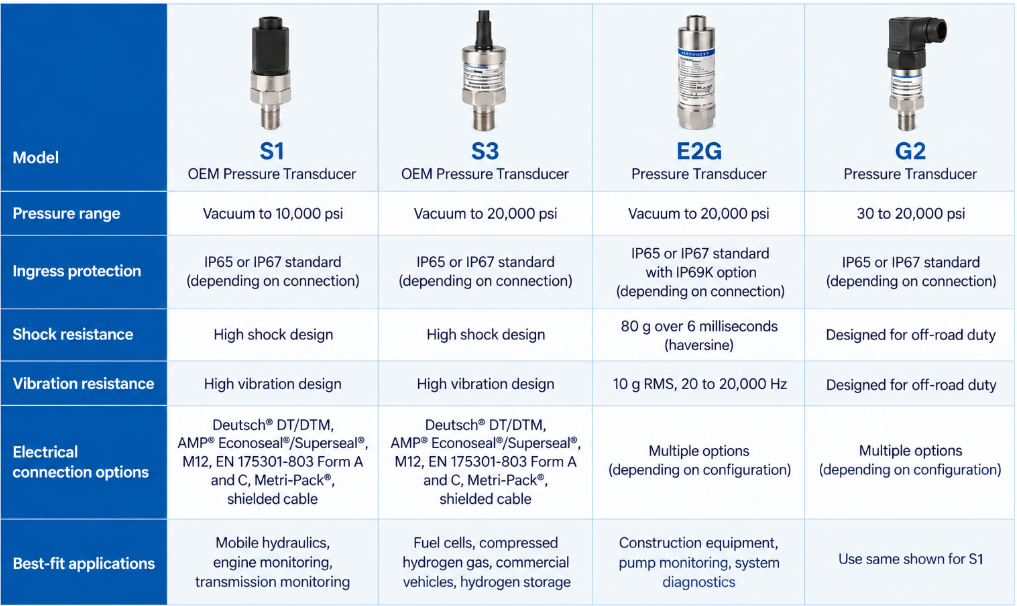
The rating can also depend on the sensor configuration. For example, the Ashcroft® OEM Pressure Transducers, S1 and S3, offer environmental ratings to IP65 (NEMA 4) or IP67 (NEMA 6), depending on the electrical connection selected. The E2G, on the other hand, is rated IP66 (NEMA 4X) or IP67 (NEMA 6), depending on the electrical connection selected as standard, with an IP69K option also available.
The important point is to match the environmental rating to both the installation conditions and the specific sensor configuration rather than simply selecting the highest available IP rating.
Which pressure range fits your application?
The pressure range should match the conditions the sensor will actually measure, not simply the highest pressure it can withstand. Off-highway hydraulic systems are commonly subjected to overpressures through spikes at pressures beyond the rated full scale measuring pressure of the transducer.
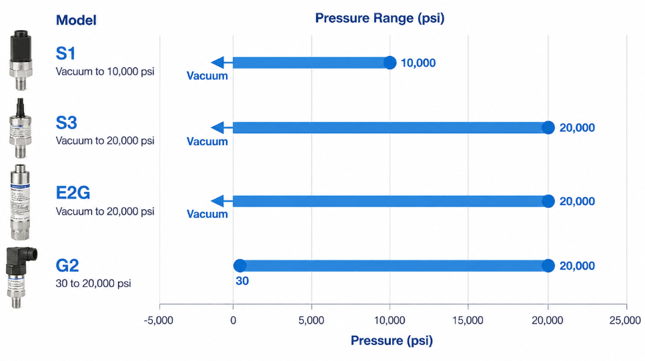
When comparing the Ashcroft® S1, S3, E2G, and G2 pressure transducers, there are several important differences:
- The Ashcroft S1 OEM Pressure Transducer measures from vacuum to 10,000 psi and can be used for applications such as mobile hydraulics, engine monitoring, and transmission monitoring.
- The Ashcroft S3 OEM Pressure Transducer extends from vacuum to 20,000 psi for higher-pressure applications. It can be used for hydrogen applications, including fuel cells, compressed hydrogen gas, commercial vehicles, and hydrogen storage.
- The Ashcroft E2G Pressure transducer also covers vacuum to 20,000 psi and provides another option for applications ranging from mobile diagnostics to pump monitoring.
- The Ashcroft G2 pressure transducer covers 30 to 20,000 psi, making it suitable for a broad range of construction and off-road hydraulic circuits. Because its range starts at 30 psi rather than vacuum, it is not intended for true vacuum or very low-pressure measurement.
A sensor with a higher maximum pressure is not necessarily the better choice. The measurement span needs to cover the expected operating conditions, including low-pressure or vacuum conditions when they are part of the application.
Figure 2. Pressure range by OEM transducer model
Which electrical connector belongs on a vehicle-mounted sensor?
The electrical connector can be just as important as the sensing element because it is exposed to vibration, moisture, and other environmental conditions along with the rest of the sensor.
The S1 and S3 pressure transducers, along with the other Ashcroft models discussed in this article, offer several electrical connection options. The right choice depends on the equipment design, wiring harness, installation environment, and required environmental rating.
Options include:
- Deutsch® DT/DTM: Sealed electrical connection options commonly used on off-highway vehicles.
- AMP® Econoseal®/Superseal®: Additional sealed connection options for OEM installations.
- M12: A threaded, easy-to-wire connection available in multiple configurations.
- EN 175301-803 Form A and C: Commonly referred to as DIN 43650 Form A and C connections with internal screw terminals allowing in-field quick installations.
- Metri-Pack® and shielded cable: Additional options for OEM integration, including applications where a shielded cable is required.
Why should you consider the connector and environmental rating together?
The electrical termination selected can affect the environmental rating of the complete sensor configuration.
For the Ashcroft® S1 and S3, the Metri-Pack®, shielded cable, Deutsch® DT/DTM, AMP® Econoseal® /Superseal®, and M12 electrical connections are rated IP67/NEMA 6X. EN 175301-803 Form A and C connections are rated IP65/NEMA 4X.
This is why the electrical connection and required environmental protection should be considered together when specifying a pressure transducer for mobile equipment.
How do pressure sensor options compare?
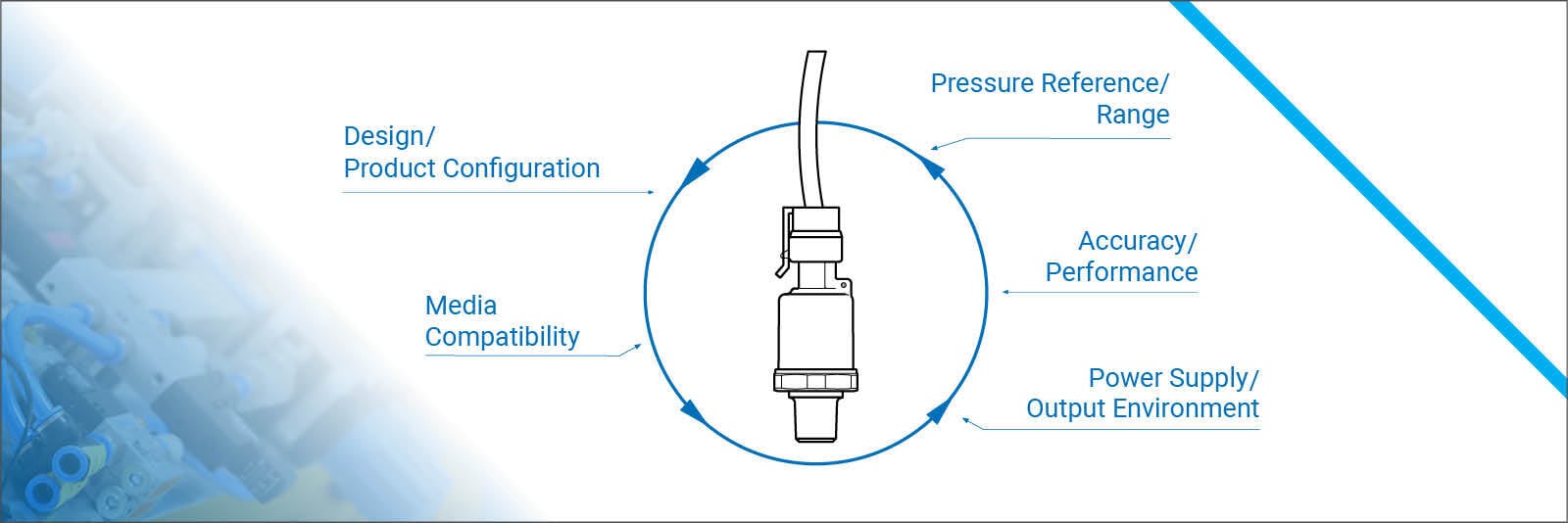
There is no single pressure transducer that is right for every off-highway application. Pressure range, environmental exposure, shock and vibration, electrical connection requirements, and the specific application all help determine the appropriate option.
Figure 3. Pressure range by OEM transducer model
What should you consider when choosing a pressure sensor for off-highway equipment?
Start with the pressure requirements, then consider everything the sensor will encounter once it is installed on the vehicle.
A few questions can help narrow the options:
- What pressure range will the sensor measure? Consider normal operating pressure, maximum system pressure, and whether the application requires low-pressure or vacuum measurement.
- How much shock and vibration will it experience? Review both ratings because they represent different mechanical stresses.
- Will the sensor encounter water, mud, or washdown? Select an environmental rating appropriate for the actual operating conditions.
- What electrical connection does the vehicle require? Consider the existing wiring harness, environmental exposure, and electrical requirements.
- Does the connection affect the environmental rating? Check the rating for the specific sensor configuration rather than assuming every configuration of a model provides the same protection.
- Where will the sensor be mounted? Engine bays, chassis locations, and exposed hydraulic systems can place very different demands on the same sensor.
Looking at these requirements together helps narrow the selection to a pressure sensor designed for both the measurement task and the environment in which it has to operate.
Learn more
For more information about pressure measurement in off-highway and mobile equipment, explore the additional resources below. Contact us if you have additional questions. In the meantime, download our guide to learn how to avoid common mistakes OEMs make when selecting pressure sensors.