

Subscribe now and get the latest blog posts delivered straight to your inbox.
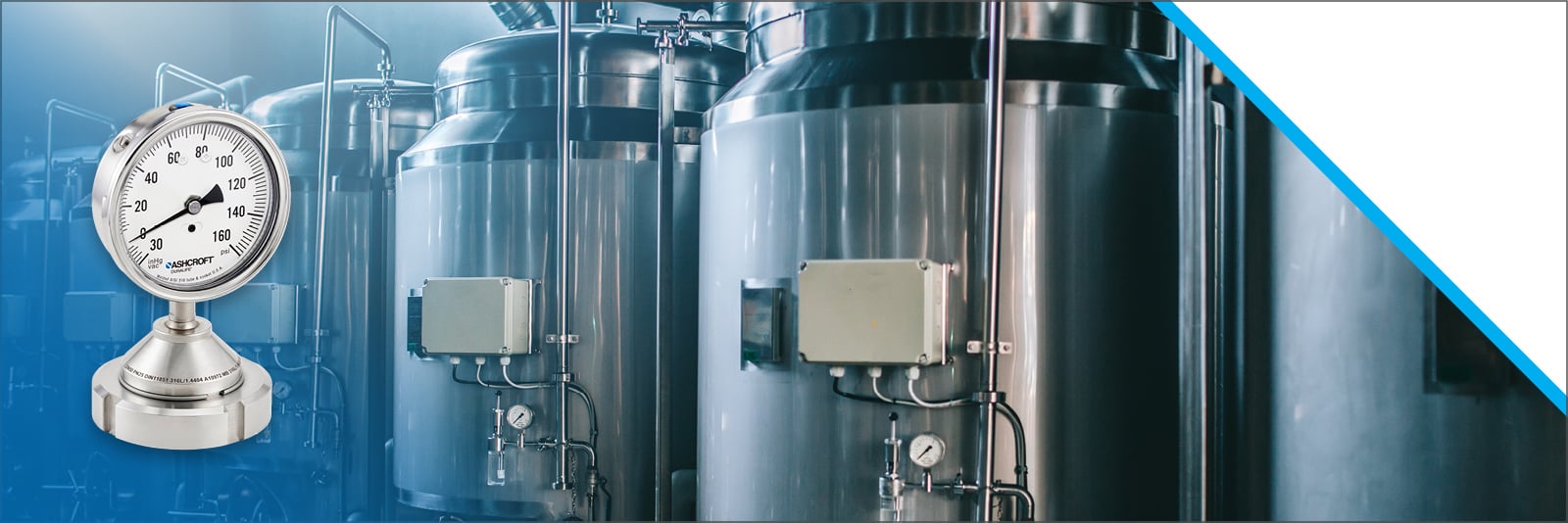
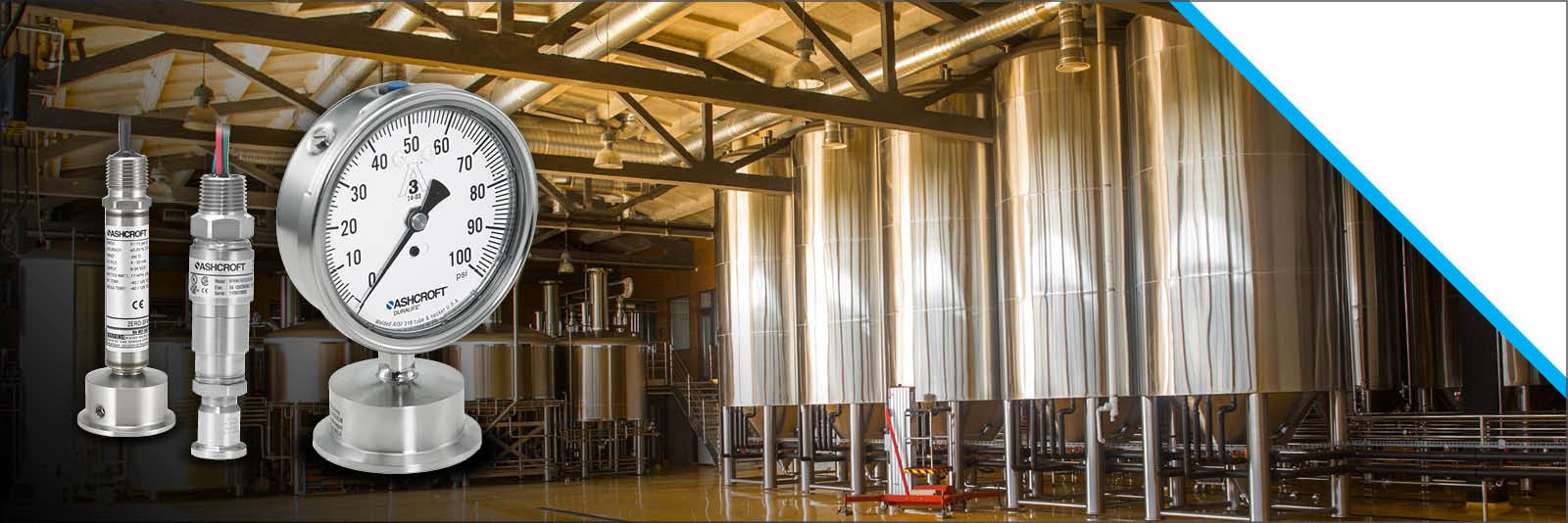
The right pressure gauge for a brewery must match the process media, pressure range, sanitary connection, cleaning method and operating conditions at the measurement point.
Pressure gauges are used throughout brewing operations, but not every application has the same requirements or needs a sanitary connection. Read this article to learn where gauges are used, which selection factors matter most and how different gauge designs may support specific brewing applications.
Ashcroft has more than 170 years of experience helping manufacturers select pressure instruments for demanding industrial and sanitary processes.
Where are pressure gauges used in brewery operations?
Pressure gauges are used throughout breweries to help operators monitor process conditions, maintain consistent production and identify potential problems. Here are common areas where pressure measurement is needed:
- Fermentation and conditioning vessels: Monitors pressure as beer moves through fermentation, maturation and storage
- Bright beer tanks: Helps maintain appropriate conditions for carbonation, storage and transfer to packaging equipment
- Filtration systems: Monitors pressure before and after filtration equipment, where changes may indicate increasing resistance or restricted flow
- Product-transfer systems: Confirms operating conditions as wort or beer moves between vessels or processing stages
- CIP systems: Monitors cleaning-fluid pressure during circulation
- Packaging systems: Supports consistent pressure during filling, canning or bottling
- CO₂ and utility systems: Measures gas, compressed air, water, steam and other support-system pressures
Why are sanitary pressure gauges important in breweries?
Not every gauge used in a brewery requires sanitary construction. However, sanitary pressure gauges are generally needed at measurement points that come into contact with the product or cleaning media. Their unique design supports effective cleaning and helps minimize crevices and other areas where wort, beer, yeast or microorganisms could collect.
The sanitary connections minimize crevices and recessed areas where process material can remain after production. Wetted materials and surface finishes must also be compatible with the product, cleaning chemicals and temperatures encountered during brewing and cleaning. These gauges may be appropriate when it directly contacts wort, beer, yeast-bearing liquid or cleaning media in a hygienic process line.
Important selection considerations include:
- Cleanable design: Allows cleaning fluid to reach product-contact areas effectively
- Compatible wetted materials: Resists corrosion from beer, wort, water and cleaning solutions
- Smooth surface finish: Helps minimize areas where residue and microorganisms can collect
- CIP compatibility: Withstands the cleaning media, pressure and temperature used in the system
A standard industrial gauge, on the other hand, may be suitable for a utility-water or gas measurement point that does not contact the product.
Note: Breweries must comply with applicable FDA current good manufacturing practices, TTB brewery requirements and state or local regulations. Although 3-A certification is not generally required for brewery pressure gauges, 3-A hygienic-design principles can help breweries select cleanable instruments that minimize areas where residue may collect.
What should you consider when choosing a brewery pressure gauge?
Choosing a brewery pressure gauge starts with understanding the application rather than selecting a particular gauge model. The answers to the following questions will help you find the right instrument for your application:
1. What media will contact the gauge?
The process media determines which wetted materials and gauge design are appropriate. A gauge may contact wort, finished beer, yeast-bearing liquid, cleaning solutions, water, gas or another utility medium. Product-contact applications generally require sanitary construction, while utility applications may have different material and connection requirements.
316L stainless steel is commonly used for sanitary wetted components because it provides corrosion resistance and can be finished to create a smooth, cleanable surface. Material compatibility should still be confirmed for the specific process media and cleaning chemicals.
2. What pressure and temperature conditions will the gauge experience?
The gauge range should make normal operating pressures easy to read while accommodating the application’s highest expected pressure and temperature.
Consider the following conditions:
- Normal operating pressure: Select a range that makes typical process changes easy to see
- Maximum pressure: Account for the highest pressure expected during production, startup, cleaning or an abnormal condition
- Vacuum or compound pressure: Determine whether the application may experience vacuum as well as positive pressure
- Pressure cycling: Consider how frequent pressure changes may affect the sensing element and movement
- Process and cleaning temperatures: Confirm that the gauge, fill fluid and connection can tolerate production and CIP temperatures
A pressure gauge indicates system conditions but does not replace properly selected pressure-relief equipment.
3. Which process connection does the equipment use?
The pressure gauge must match the sanitary connection installed on the vessel, piping or process skid.
Tri-Clamp connections are widely used in North American sanitary processing systems, while DIN 11851 hygienic unions may be found on European, imported or DIN-configured brewing equipment. Neither connection is automatically better for brewing. The correct choice depends on the equipment design and the brewery’s established connection standard.
For example, the Ashcroft® 1032 Sanitary Pressure Gauge supports 1½-inch and 2-inch Tri-Clamp installations, while the Ashcroft® 1033 Sanitary Pressure Gauge is designed for DIN 11851 hygienic connections. Both may be used on vessels, filtration systems or process skids when their specifications match the application.
4. Could material collect around the sensing diaphragm?
Gauge installations should minimize areas where yeast, sediment, hops or other process material can collect.
A conventional sanitary connection may be suitable for many vessels and process skids. However, media containing suspended solids or material that tends to coat surfaces may be more difficult to remove from a recessed connection.
An in-line design positions the diaphragm directly in the process flow, reducing the dead leg and improving access during cleaning. The Ashcroft®1036 Sanitary Pressure Gauge, used with a compatible a 1037 in-line Sanitary Instrument Fitting, is one example. This type of design may be considered for yeast-bearing lines, filtration skids, product-transfer systems and CIP supply or return lines.
5. Will vibration or pulsation affect the reading?
Vibration and pump pulsation can make a gauge difficult to read and increase wear on its internal components.
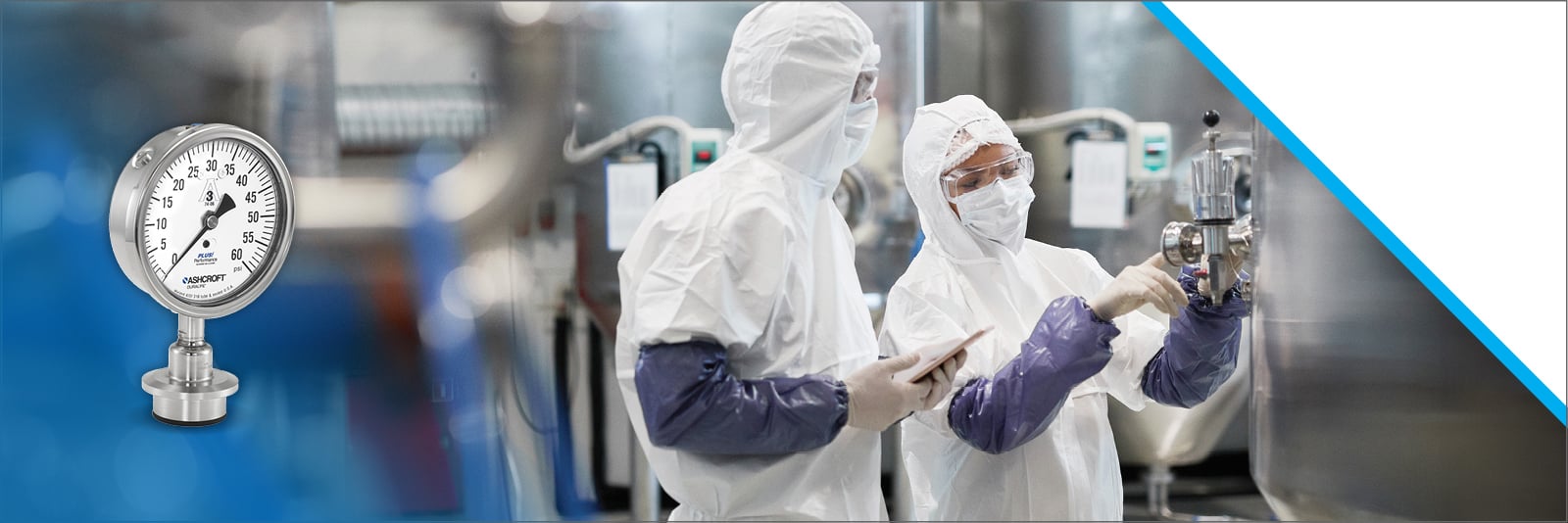
Liquid filling or another dampening method may help stabilize the pointer on transfer systems, filtration skids and other equipment that produces vibration or pressure fluctuations. Another option is an Ashcroft® PLUS!™ Performance option. PLUS!™ Performance uses dampening media around the gauge movement to reduce pointer flutter while maintaining a dry gauge case. This option is available with select gauges, including the 1032 sanitary pressure gauge.
The dampening method must suit the gauge, process and operating temperature. PLUS! Performance is not recommended when the gauge will be exposed to temperatures above 200 °F (93 °C), including during autoclaving. Cleaning and sterilization temperatures should therefore be reviewed before specifying it.
Washdown exposure, mounting position, dial size and access for inspection or replacement should also be considered.
Do microbreweries and large production breweries have different gauge needs?
Microbreweries and large production breweries may use gauges in similar applications, but their monitoring, maintenance and system-integration needs can differ.
| Consideration | How brewery scale may affect gauge selection |
|---|---|
| Process monitoring | Microbreweries may rely more on local readings, while larger breweries may pair gauges with transmitters for centralized monitoring and automated control. |
| Cleaning | Larger facilities are more likely to use automated and documented CIP cycles, although cleanability matters at every production scale. |
| Maintenance | High-volume facilities may place greater emphasis on standardized specifications, calibration schedules and replacement procedures. |
| Downtime | As production volume and process complexity increase, reliability and ease of replacement may become more consequential. |
These are general operational differences rather than fixed rules. Regardless of brewery size, gauge selection should begin with the requirements at the measurement point.
What should you remember when selecting a brewery pressure gauge?
The best pressure gauge for a brewery is the one that meets the requirements of the specific application.
Keep these priorities in mind:
- Start with the media, pressure range, temperature and operating conditions
- Determine whether the gauge contacts the product and requires sanitary construction
- Match the gauge to the existing process connection
- Consider CIP compatibility, surface finish and areas where residue could collect
- Evaluate vibration, pulsation, washdown exposure, readability and maintenance needs
- Confirm that the gauge and pressure-relief equipment are properly selected for the vessel or system
Brewery size may affect how pressure readings are monitored and documented, but it does not replace an application-based selection process.
Learn more about sanitary pressure gauge selection
Pressure gauges are one part of maintaining clean, safe and consistent brewery operations. If you have questions, contact us. In the meantime, check out the related resources below, and read Considerations for Choosing a Sanitary Pressure Gauge for more information about sanitary materials, cleaning methods, surface finishes and connection options. Or, if you want to avoid common mistakes when choosing a pressure gauge, download our guide.