

By:
Steve St. Hilaire
Director of Electronic Product Sales Support
Published on:
September 27th, 2021
Topics:
Subscribe now and get the latest blog posts delivered straight to your inbox.
By:
Steve St. Hilaire
Director of Electronic Product Sales Support
Published on:
September 27th, 2021
Topics:
If you work in the semiconductor industry, you know that there are applications that require specialized equipment to handle corrosive liquids or gases, such as cleaning and wet etching. These processes use corrosive chemicals and ultra-high purity water.
Chip manufacturers need to control these liquids accurately. The pressure transducer used must be anti-corrosive, low metal ion elusion and, of course, accurate. When your semiconductor process requires pressure measurement, you need the best instruments for the job.
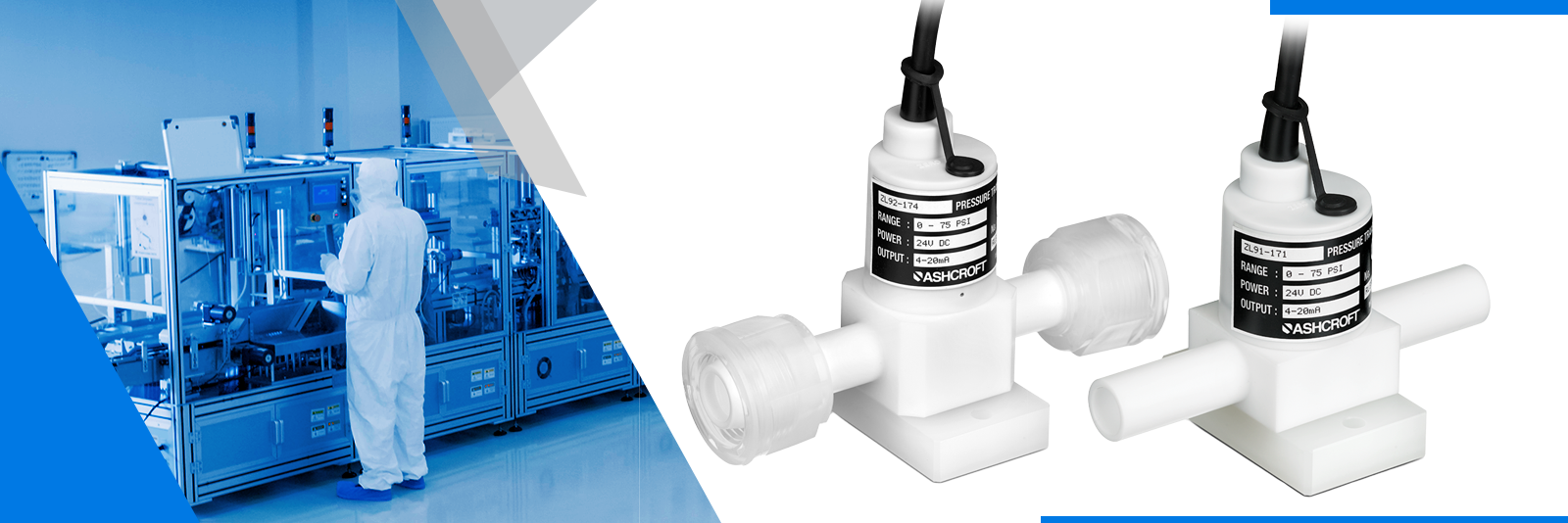
Pressure transducers for the semiconductor industry need to be designed and manufactured with materials that prevent contamination in your process, and our new ZL91 and ZL92 fluoropolymer pressure transducers fit the bill.
Let’s look at the features of these transducers and how they can work for your semiconductor applications.
Important Features
These transducers handle specific applications where you need chemical compatibility along with low metal ion elusion to keep the process pure.
The unique design of the ZL91 and ZL92 fills a niche gap in the popular semiconductor market, which has been struggling to meet the market’s demand for wafers and components.
Materials
The Ashcroft ZL91 pressure transducer is designed for ultrapure and de-ionized water applications. It is constructed with fluoropolymer (PTFE/PFA) wetted parts that minimize metal ion elution. Its compact design helps to reduce contamination and maintain the purity of your process fluid.
The Ashcroft ZL92 pressure transducer is designed for use in semiconductor processes that require PTFE/PFA wetted parts for improved chemical compatibility for use in corrosive gases and fluids, including Hydrofluoric acid or other aggressive acids. A secondary isolation diaphragm and vent design isolate the ceramic sensing element from corrosive gases and liquids, which extends the life span of the transducer.
Specifications
ZL91:
Pressure Ranges:
Gauge and compound ranges from 15 psi up to 75 psi
Process Connection:
Tube connection sizes include: 1/4 in., 3/8 in., 1/2 in., 3/4 in. and 1 in.
Accuracy: ±1.0% of span at 73°F (23°C)
Accuracy includes the effects of linearity, hysteresis and repeatability.
ZL92:
Pressure Ranges:
0-45 psi to 0-75 psi
Process Connection:
Tube connection sizes include: 1/4 in., 3/8 in. and 1/2 in.
Accuracy: ±1.0% of span at 73°F (23°C)
Accuracy includes the effects of linearity, hysteresis and repeatability.
Industries and Applications
These specialized transducers are perfect for when standard stainless steel isn’t compatible or has issues in particular applications, or when it is not cost-effective. They are recommended for use in the following industries and applications:
ZL91:
- Ultrapure/deionized water facilities
- Ultrapure/deionized water production equipment
- Cleaning equipment for semiconductor
- Cleaning equipment for Flat Panel Displays (FPD)
- Wet stations
ZL92:
- Cleaning equipment for semiconductor
- Cleaning equipment for Flat Panel Displays (FPD)
- Wet etching systems
- Wet stations
- Chemical supply systems
Pros and Cons
There are many positive attributes of the ZL91 and ZL92. These transducers are easy to install in your system or process, using a wide selection of compression fittings and tube stub unions.
The ZL92 offers many of the same advantages as the ZL91 but it also incorporates Ashcroft’s parent company, Nagano Keiki’s patented design that protects the sensing element from gasses created in acid or corrosive applications that can permeate through the PTFE material. This design uses an air gap and vent to extend the life of the ZL92 by allowing gasses to escape rather than collect inside the housing.
Stainless steel, which is a material commonly used to manufacture transducers, is not always compatible with these types of applications. In some cases, Hastelloy can be used but it can be quite expensive. This makes the ZL91 and ZL92 the perfect cost solution for these applications.
Wrap-Up
The ZL91 and ZL92 pressure transducers are ideal for semiconductor applications where media purity and/or corrosion resistance is required. They provide a reliable and long-lasting sensor to meet your application requirements.
Check out the data sheets for the ZL91 and ZL92 for all the specs and more information on these new transducers.
If you want to learn more about pressure transducers, Ashcroft has many white papers, webinars and guides in the resource center.
Reach out today to talk to one of our industry experts and get your questions answered. Or take a look at our guide:
.png?width=1600&height=534&name=Choosing%20Pressure%20Sensor%20for%20OHV_BLOG%20(1).png)