
-1.jpeg?width=50&height=50&name=dll%20(2)-1.jpeg)
Subscribe now and get the latest blog posts delivered straight to your inbox.
This article was originally published on October 4th, 2021. and updated on November 11, 2024.
There are many reasons to customize your pressure gauge dial. Whether it's for corporate branding, compliance, application-specific requirements or just a desire to have uniformity in your process, your decision is based on your unique business needs.
As a product leader in pressure gauges at Ashcroft, I understand that standard instruments may not always meet the specific needs of our customers. My job is to understand your objectives and deliver a tailored solution that addresses your unique requirements.
In this article, you will learn why custom pressure gauge dials can help you and your business. You will also see how easy it is to order a custom dial from Ashcroft and gain access to additional resources that can help you find the best pressure gauge for your application.
What industries order customized pressure gauge dials and why?
There are many industries and applications that require custom pressure gauge dials, including automotive services/support diagnostics, fluid power hydraulics, fire safety/sprinkler systems and filtration systems to name a few. In each instance, the need is driven by specific requirements and benefits.
Here are some common reasons businesses opt for custom dials:
- Branding and Identity: An Original Equipment Manufacturer (OEM) may require a gauge that prominently displays their company name, enhancing brand visibility and identity on their equipment.
- Marketing and Contact Information: Companies often choose to include their logo, website address, and phone number on the gauge, turning it into a marketing tool that provides essential contact information.
- Procurement and Maintenance: Purchasers may want to streamline the procurement of replacement parts by adding their contact details to the gauge, ensuring easy access to necessary components.
- Safety and Operational Efficiency: Adding color zones to the dial can significantly improve safety by clearly marking danger zones or indicating when maintenance is required, thus preventing accidents and ensuring smooth operations.
- Visual Clarity and Precision: Changing the color of the graduations on the dial can enhance readability and precision, making it easier for operators to take accurate readings.
- Process Identification: Labeling the lines for inputs and outputs related to process media helps in quick identification and reduces the risk of errors during operation.
- Specialized Measurement Needs: Some applications demand specialized scales on the dials to accommodate multiple units of measure, ensuring that the gauge meets specific operational requirements.
- Unique Measurement Units: Customers may need a dial that displays a unique or non-standard unit of measure, or converts pressure readings to other metrics such as Flow, Level, Load, or Torque, to better suit their application needs.
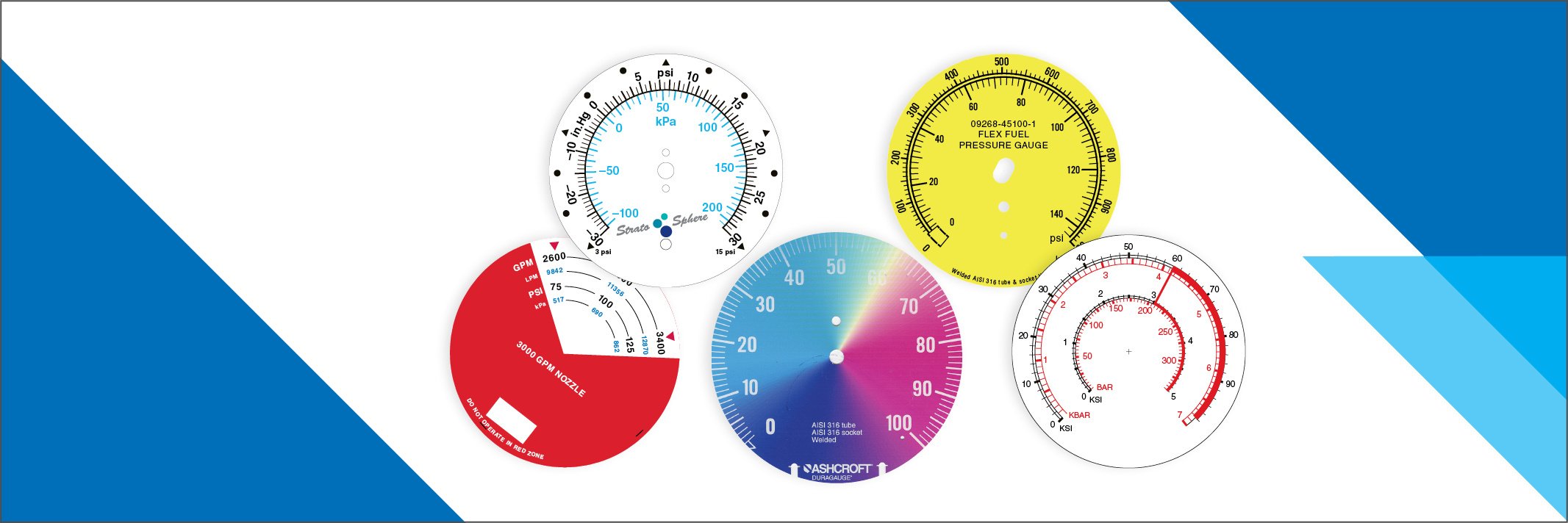
Elements of a pressure gauge dial that can be customized.
Here's what you can add to your pressure gauge dial to customize it for your needs:
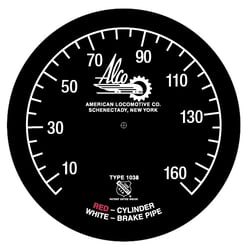
- Branding: High-resolution custom logos with your brand colors let operators know who is protecting their process simply by looking at the dial. We use True PMS® ink matching and opaque white UV-cured ink to resist fading.
Figure 1. Pressure Gauge Dial Branding Example.
-
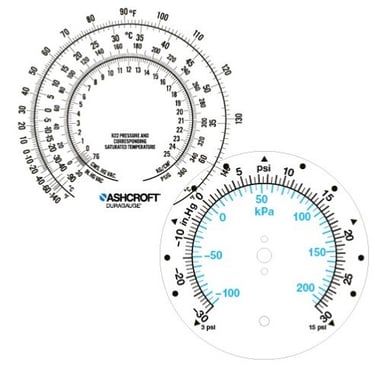
Multiple Scales: Single, double and triple scales display pressure readings simultaneously.
Figure 2. Multiple Scale Example.
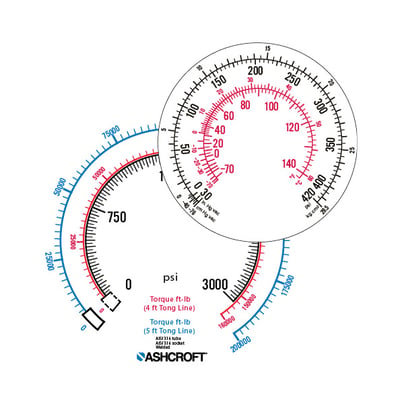
- Alternate Scales: Alternate scale options, including torque, temperature and force, relate pressure to scales to better fit your application.
Figure 3. Alternate Scale Example.
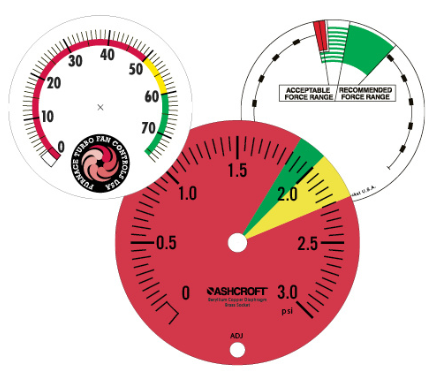
- Zone Indicators: Zones marked with color bands allow operators can quickly identify and process pressure measurements in safe, cautious or dangerous states.
Figure 4. Zone Indicator Example.
- Tag Numbers: Tag numbers, approvals or application directives provide operators with essential technical information for easy communication and documentation.
Figure 5. Tag Number Example.
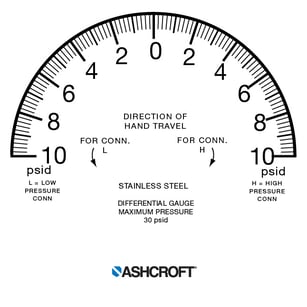
How to order a custom pressure gauge dial in three easy steps.
Ordering custom dials from Ashcroft is simple. Here's what to do:
1. Get Started
To begin, contact us at Ashcroft either online or through your designated territory manager. Alternatively, you can reach out to your authorized distributor. They will assist you in finding the best customization options for your needs.
2. Submit Your Artwork
Submitting your artwork to Ashcroft is simple, but there are a few guidelines to follow. Our Custom Dial Product Information Page provides all the details, but here are some key points:
- Use an Adobe Illustrator file format (.ai or .eps) from either a Mac or PC.
- Ensure the line art file includes any specified PMS ink(s) needed to accurately reproduce your logo/graphics.
- Convert all fonts to outlines or include them with the file.
- Avoid linked or embedded bitmap images.
3. Review and Approve Your Proof
After submitting your artwork, expect a one to two-day turnaround before receiving a proof for your approval. If needed, you can also request samples (for OEMs, we’ll send you a gauge).
Upon receiving your proof, verify that it meets your expectations and looks professional. Consider how your artwork appears with the dial size (some logos may need adjustments if they are too small, or you might require a larger dial).
The production of your custom product follows our standard lead time, so customization doesn’t significantly extend the process.
A unique code will be assigned to your part number, ensuring it is exclusively available to you in the future and not shared with other customers.
Ready to get started?
Now that you understand the benefits of customizing your pressure gauge dial and the steps for placing an order, start thinking about how customization can help your business and what you would like your equipment to look like.
Ashcroft custom dials enhance the visual presentation of your equipment and maximize the utility of the pressure or temperature indicator. If you want to learn more about pressure gauges, feel free to visit our website.
Here are a few articles that may be of interest to you.
- How To Identify Your Pressure Gauge and Get the Proper Replacement
- Why Did My Pressure Equipment Fail? 6 Instrument Killers
- How Do I Select the Right Pressure Gauge Range?
Feel free to contact us today to talk to one of our industry experts and get all your pressure gauge and customization questions answered. In the meantime, check out our pressure gauge selection tool to help you find the best instrument for your needs. 
Topics: