

By:
Paul Francoletti
Director of Product Sales – Mechanical
Published on:
March 4th, 2024
Last updated on:
February 18th, 2026
Topics:
Subscribe now and get the latest blog posts delivered straight to your inbox.
By:
Paul Francoletti
Director of Product Sales – Mechanical
Published on:
March 4th, 2024
Last updated on:
February 18th, 2026
Topics:

Pressure instruments fail audits for six primary reasons: excessive pulsation or vibration, operating outside temperature limits, pressure spikes, clogging, corrosion and improper installation.
Pressure gauges and other mechanical instruments provide critical visibility into system performance. When they degrade or fail, you lose confidence in the data that drives operational decisions.
After years of conducting comprehensive instrument audits across refining, chemical, and power environments, we consistently see the same root causes. The good news: most audit failures are preventable when early warning signs are recognized and corrective action is taken.
Read this article to learn the early indicators that signal pressure instrument problems and practical solutions to prevent these issues from happening in the first place.
What are the early warning signs of pressure gauges failure?
Pressure gauges usually show visible or performance-related symptoms before they fail an audit. Routine inspection and maintenance make it easier to detect issues early and prevent costly downtime, rework or safety incidents. The most common warning signs include:
-
Pointer flutter. The pointer continually moves back and forth, making the gauge difficult to read.
-
Unresponsive pointer. The gauge does not react to pressure changes.
-
Dented pointer. Often indicates severe under pressure or overpressure.
-
Discolored fill fluid. Yellowing liquid in a filled gauge often signals elevated ambient temperature.
-
Deformed or melted window. A clear indication of excessive temperature exposure.
-
Black powder on dial or window. Typically caused by pulsation or vibration that wears down movement gear teeth.
These symptoms are not cosmetic issues. They point to underlying mechanical stress, environmental exposure or process conditions that will likely surface during an instrument audit.
What are the six leading causes of audit failures?
The key to overcoming problems with instruments in critical applications is to understand their causes. Below are some of the most common pressure gauge problems we have come across, including why they occur, what effects they have on the instrument and the overall operation or process, and how to resolve them.
1. Excessive pulsation or vibration is a leading cause of failure
Excessive pulsation and vibration are two of the leading causes of internal wear, pointer instability and premature gauge damage. In many processing environments, pressure surges create pulsation within the gauge. Vibration, caused by high-frequency/low-amplitude or low-frequency/high-amplitude, stresses internal components differently:
-
High-frequency vibration causes localized wear on movement gear teeth.
-
Low-frequency vibration places broader stress on the Bourdon tube and internal components.
As a practical guideline, if pointer movement exceeds approximately 5% of full-scale range due to pulsation or vibration, corrective action is required.
Solutions for excessive pulsation or vibration:
- Using liquid-filled gauges to dampen movement. You can dampen the effect of pulsations/vibrations on the gauge by filling the case with silicone, glycerin or halocarbon that includes an integrated throttle screw.
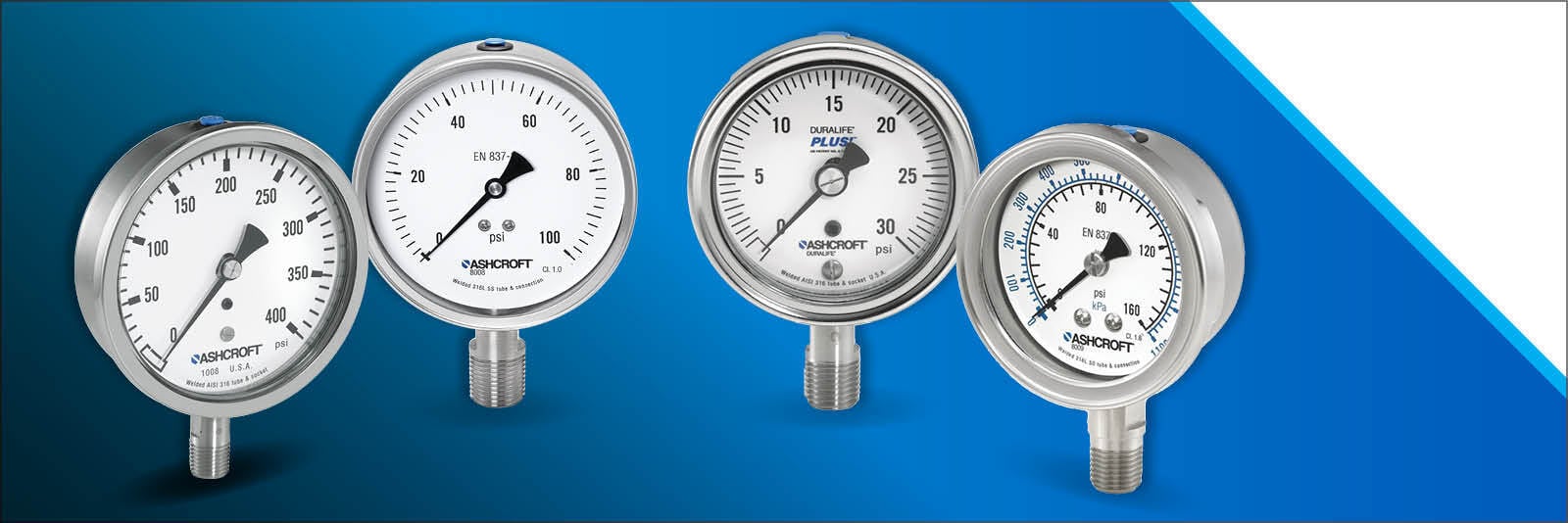
- Selecting a dry gauge with enhanced dampening features. For instance, the Ashcroft® 1279 Duragauge with PLUS!™ Performance, works like a liquid-filled gauge, dampening the effects of pulsation and vibration.
- Installing the instrument remotely. You can use a capillary line (from 1 foot to 100 feet) to mount the instrument further away from the vibration source.
- Adding pulsation dampeners, throttle screws, needle valves or diaphragm seals. These accessories dissipate pulsation before it reaches the instrument.
The objective is not just to stabilize the pointer, it is to reduce internal stress that leads to audit failure and shortened service life.
2. Operating outside temperature limits leads to accuracy drift and instrument damage
Instruments are rated for use in a specific temperature range. Using them in temperatures outside of this range can lead to significant damage, depending on their design and construction. For example:
- Dry gauges are typically rated for use in ambient temperatures below 200°F (93 °C). Above this temperature, they may experience dial discoloration, window discoloration (if acrylic) or gasket hardening. Process temperatures for dry gauges are typically rated for between -20 °F (-29 °C) to 250 °F (121 °C).
- Liquid-filled gauges are typically rated for use in ambient temperatures up to 150 °F (66 °C). Above this temperature on a liquid-filled gauge, they may experience leaching of the gasket and O-ring material and discoloring of the fill liquid. Both extremely low and extremely high temperatures can also trigger accuracy issues in instruments. A standard dry gauge can experience slowed point response time in low temperatures.
Gauge accuracy is affected when the ambient gauge temperature exceeds the temperature at which it was calibrated. As a guide, if a gauge is calibrated at 68 °F (20 °C), accuracy will be affected by approximately 0.4% per 25 °F/13.9 °C.
Solutions for excessively high or low temperature applications
-
Mounting the instrument remotely. Remote mounting protects pressure instruments from extreme process temperatures by physically separating the gauge from the heat or cold source. This is typically done using a capillary between the instrument and the process connection.
A gauge pipe mounting bracket provides a convenient and secure method for installing the remotely mounted gauge. The Ashcroft® 1115 Capillary Line is rated for temperatures from -300 °F to 750 °F (-184 °C to 399 °C), making it suitable for a wide range of demanding applications. Even a relatively short 5-foot length of capillary can significantly reduce high process temperatures reaching the instrument or help moderate extremely low temperatures.
-
Mounting the instrument directly with temperature-dissipating devices. When remote mounting is not preferred, temperature-dissipating siphons can be installed directly between the instrument and the process.
The Ashcroft® MicroTube™ and finned siphons are rigid devices that mount directly to the instrument and then to the process connection, eliminating the need for separate remote mounting hardware.
-
The MicroTube™ siphon is engineered for process pressures up to 5,000 psi and process temperatures up to 800 °F (427 °C).
-
The finned siphon is rated for pressures up to 3,000 psi and process temperatures up to 700 °F (371 °C).
-
Both designs effectively dissipate heat before it reaches the pressure instrument.
-
Incorporating a coil or pigtail siphon for steam applications. Steam applications require additional protection because of sustained high temperatures and the potential for water hammer.
Coil and pigtail siphons create a condensate barrier that shields the pressure instrument from direct steam exposure.-
A pigtail siphon is typically used for vertical mounting.
-
A coil siphon is used for horizontal mounting.
-
Before installation, the siphon loop must be filled with water. This water forms a protective barrier that reduces temperature at the instrument and helps protect against the damaging effects of water hammer common in steam systems.
3. Pressure spikes cause mechanical damage and overpressure failures
Pressure spikes can result from water hammer, rapid valve actuation, equipment malfunction or freezing process fluid. Gauges exposed to these sudden surges often exhibit damage such as a dented pointer, a deformed or ruptured Bourdon tube, or a broken segment gear. This type of mechanical stress can cause the instrument to become unresponsive to process changes or fail entirely, negatively impacting system performance.
When pressure exceeds the gauge’s full-scale range, overpressure conditions can degrade accuracy, damage internal components or rupture the Bourdon tube.
Solutions for preventing pressure spike damage
-
Using an internal stop. An internal stop, also known as an overload stop, can be incorporated to increase the proof pressure of the gauge. This feature typically raises proof pressure by approximately 20%, providing additional protection against momentary overpressure events.
-
Installing a pressure limiting valve (PLV) or selecting a gauge with high overpressure capability. A pressure limiting valve (PLV) can be set to shut off flow when pressure reaches the full-scale range of the gauge. Once process pressure drops back below full scale, the PLV automatically resets and allows pressure to pass through to the instrument.
-
Selecting a gauge designed with high overpressure capability. For example, the Ashcroft® T6500 with the XRA option is engineered to withstand overpressure up to 400% of the gauge range.
-
Selecting a new, properly rated gauge. Proper gauge selection is critical to preventing overpressure damage. The selected gauge should accommodate the maximum expected operating pressure. For optimal readability and performance, the pointer should normally operate near the 12:00 position on the dial.
If the normal operating pressure is 50 psi, a gauge with a full-scale range of 0–100 psi is typically recommended.
4. Clogging from particulates or slurries reduces instrument accuracy and reliability
Instruments installed in “dirty” processes are highly susceptible to clogging. As process media flows through the system, material can accumulate on internal surfaces or within the process connection. Over time, this buildup can restrict pressure transmission, impair instrument performance and reduce overall process efficiency.
Solution for clogging depends on the severity and nature of the buildup
-
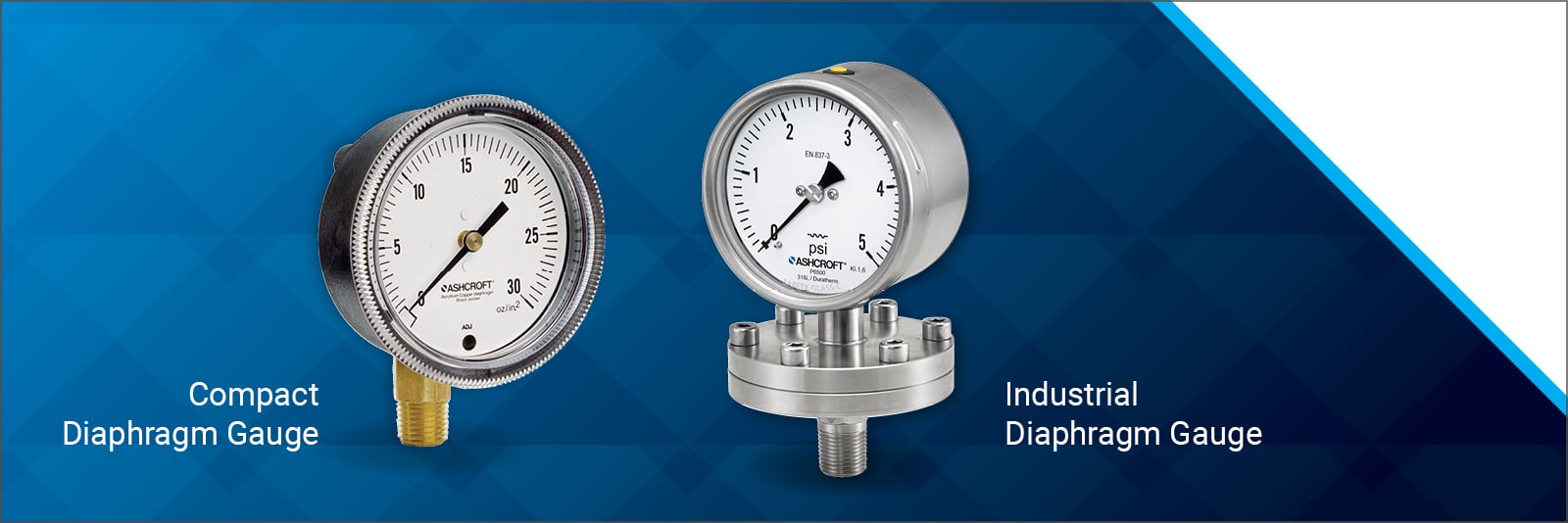
If the process connection is prone to media accumulation or blockage, isolate the instrument from the process using a diaphragm seal or isolation ring. This prevents process material from entering the instrument.
-
If clogging within the diaphragm seal itself is a concern, incorporate a flushing connection. This feature allows operators to clear accumulated media from the seal. Installing a valve on the flushing port provides controlled access for cleaning.
-
For heavy slurries or sludge, an isolation ring is often the preferred solution. Its 360-degree flow path minimizes restriction and makes clogging virtually impossible.
5. Corrosion from incompatible wetted materials creates safety risks
The wetted parts of a pressure instrument must be compatible with the process media. If they are not, corrosion can occur during operation, compromising measurement accuracy as well as product and process quality.
In severe service conditions, incompatible media can progressively degrade wetted components, eventually leading to instrument failure and loss of containment. When process media escapes into the environment, it creates a serious safety hazard that can result in operator injury or, in extreme cases, loss of life.
Solutions to prevent corrosion
To prevent corrosion-related failures, verify that the instrument’s wetted materials are suitable for the process media’s composition, concentration and temperature. If compatible wetted materials are not available for the instrument itself, integrate a diaphragm seal (instrument isolator) or isolation ring constructed from a material designed to withstand the process conditions.
For additional guidance, use the Ashcroft® Material Selection & Corrosion Guide to evaluate compatibility before specifying the instrument.
6. Improper installation or handling can cause instruments to fail
Pressure instruments are precision devices that can be damaged if not handled properly. For instance, if you are using the gauge case instead of an open-ended wrench to tighten during installation, over-torquing the NPT connections, or using the instrument as a step or support, your instrument is likely to fail overtime.
Solutions to prevent failure from instrument abuse
-
Always use an open-ended wrench on NPT connections
-
Avoid applying torque to the case
-
Inspect routinely for leaks, wear and calibration drift
Many audit failures are mechanical in nature and entirely preventable through proper installation training and inspection practices.
Ready to learn more?
Now that you know the most common reasons why pressure gauges fail and the warning signs to look for, you are in a much better position to keep your people and processes safe and secure. Contact us any time to talk to one of our industry experts or request a Critical Application Solutions Experts® (CASE®) audit for your company.
In the meantime, download our guide to learn how to avoid pressure equipment failure.
Topics: