

Subscribe now and get the latest blog posts delivered straight to your inbox.
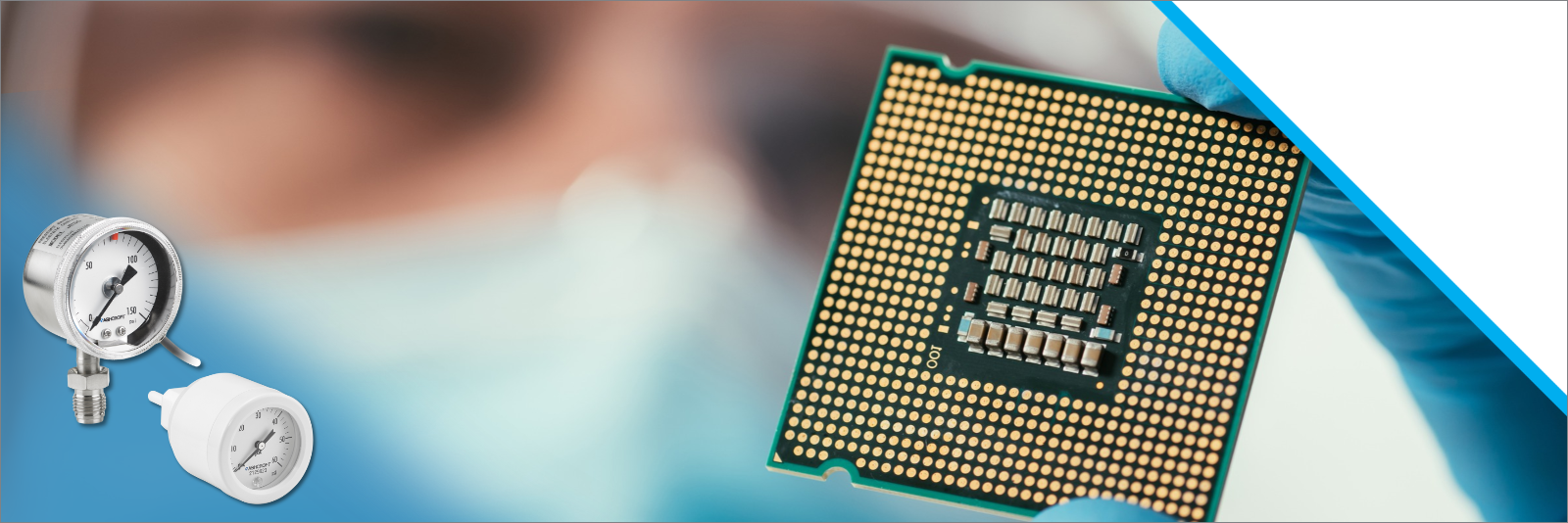
Different semiconductor manufacturing systems require different types of pressure gauges because the process media, contamination risks and operating conditions vary. Industrial pressure gauges may be appropriate for general plant utilities, while high-purity gas delivery and corrosive liquid systems often require specialized instruments.
Choosing the right gauge helps support reliable pressure measurement while addressing the cleanliness, chemical compatibility and performance requirements of each application.
Read this article to learn:
- Why semiconductor facilities use different types of pressure gauges
- Where industrial pressure gauges are appropriate for plant utilities
- When high-purity pressure gauges are needed for gas delivery
- Which pressure gauges are used for corrosive liquids and ultrapure water
- How pressure switches support gas supply systems
- What to consider when selecting a gauge for each application
Why do semiconductor facilities use different types of pressure gauges?
Semiconductor facilities use different pressure gauges because no single instrument is appropriate for every air, gas and liquid system. The requirements depend on what is being measured, how sensitive the process is to contamination and the conditions the instrument must withstand.
Three common application areas illustrate these differences:
- Plant utilities: General-purpose air and other compatible utility systems may use industrial pressure gauges where specialized high-purity construction is not required.
- High-purity gas delivery: Process gas systems may require specially cleaned, leak-tested instruments to help prevent contamination and maintain system integrity.
- Liquid processing: Corrosive chemical delivery and ultrapure water systems may require nonmetallic wetted materials to resist chemical attack and reduce contamination risks.
The appropriate instrument depends on the requirements of the specific measurement point, not simply its location within the facility.
Where are industrial pressure gauges used in semiconductor plant utilities?
Industrial pressure gauges are commonly used in semiconductor plant utility systems where the media are compatible with the gauge's wetted materials and specialized high-purity construction is unnecessary.
Compressed air and other general utility systems help support manufacturing operations. Although reliable pressure measurement is important, these applications may not have the same contamination-control requirements as high-purity process gas delivery.
For example, the Ashcroft® 8008S pressure gauge may be suitable for compatible industrial utility applications.
When selecting a gauge for these systems, consider:
- Media compatibility: Verify that the wetted materials are suitable for the air, gas or liquid being measured.
- Operating conditions: Evaluate pressure range, temperature, vibration and pressure fluctuations.
- Installation requirements: Confirm the process connection, dial size and mounting configuration.
Not every pressure measurement point in a semiconductor facility requires a high-purity gauge. However, an industrial gauge should only be used when its materials, construction and performance meet the requirements of the specific application.
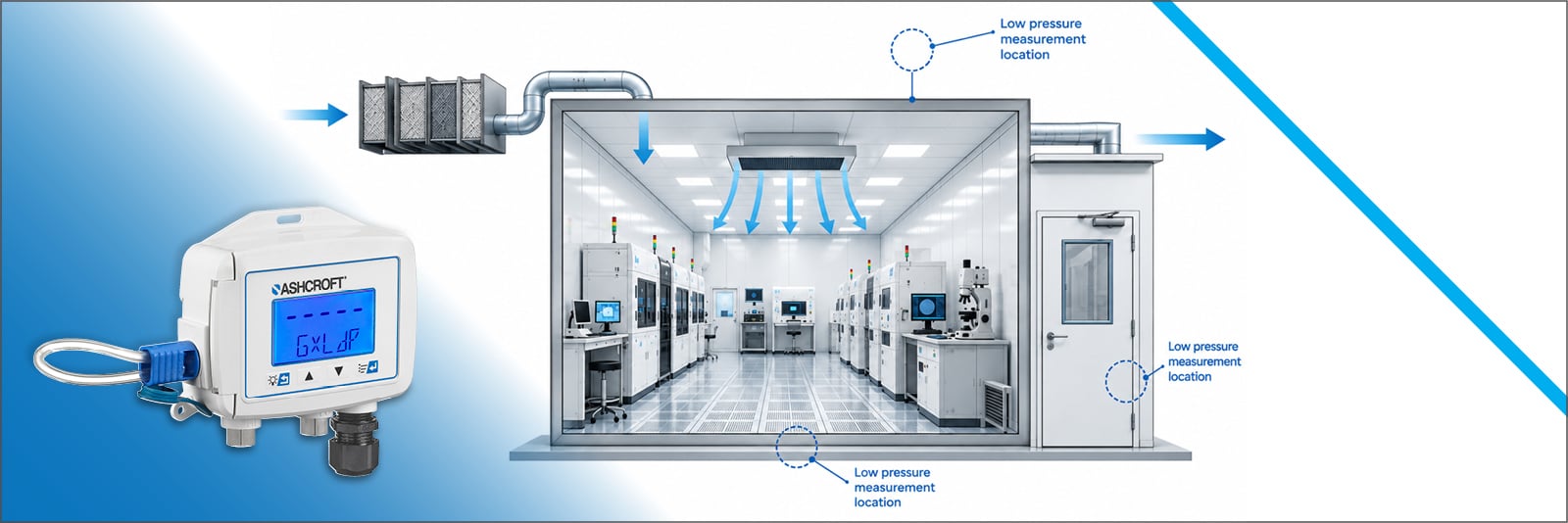
Cleanroom airflow and room pressurization are separate measurement needs that may involve differential pressure instruments. For more information, read How are air systems monitored in semiconductor manufacturing?.
When are high-purity pressure gauges needed in semiconductor gas delivery systems?
High-purity pressure gauges are used in semiconductor gas delivery systems where contamination control, leak integrity and material compatibility are critical to process performance.
Semiconductor manufacturing relies on process gases for operations such as deposition, etching and cleaning. Depending on the gas and application, unwanted particles, moisture or other contaminants can affect process consistency and product quality.
High-purity gauges may require features beyond those found in standard industrial instruments, including:
- Specialized cleaning: Helps remove particles, oils and manufacturing residues before installation.
- Leak testing: Verifies instrument integrity according to specified test requirements.
- Controlled wetted surfaces: Helps address contamination risks associated with internal instrument surfaces.
- Compatible connections: Supports installation within high-purity gas delivery assemblies.
The Ashcroft® HPX High Purity Pressure Gauge, for example, uses 316L stainless steel wetted components and is designed for applications such as gas sticks, process gas analyzers and bulk gas systems. The HPX is cleaned in a Class 100 environment and helium leak tested.
A stainless steel gauge is not automatically suitable for high-purity service. Its cleaning, construction, leak testing and connections must meet the system's requirements. For additional selection guidance, read How do you select a UHP pressure gauge for semiconductor applications?
Which pressure gauges are used in corrosive liquid and ultrapure water systems?
Pressure gauges with fluoropolymer wetted parts are often used in semiconductor corrosive liquid and ultrapure water systems where chemical compatibility and contamination control are important.
Liquid processing applications can involve aggressive chemicals used for wafer cleaning, wet etching and other manufacturing steps. These media may damage incompatible metallic components or introduce unwanted contaminants.
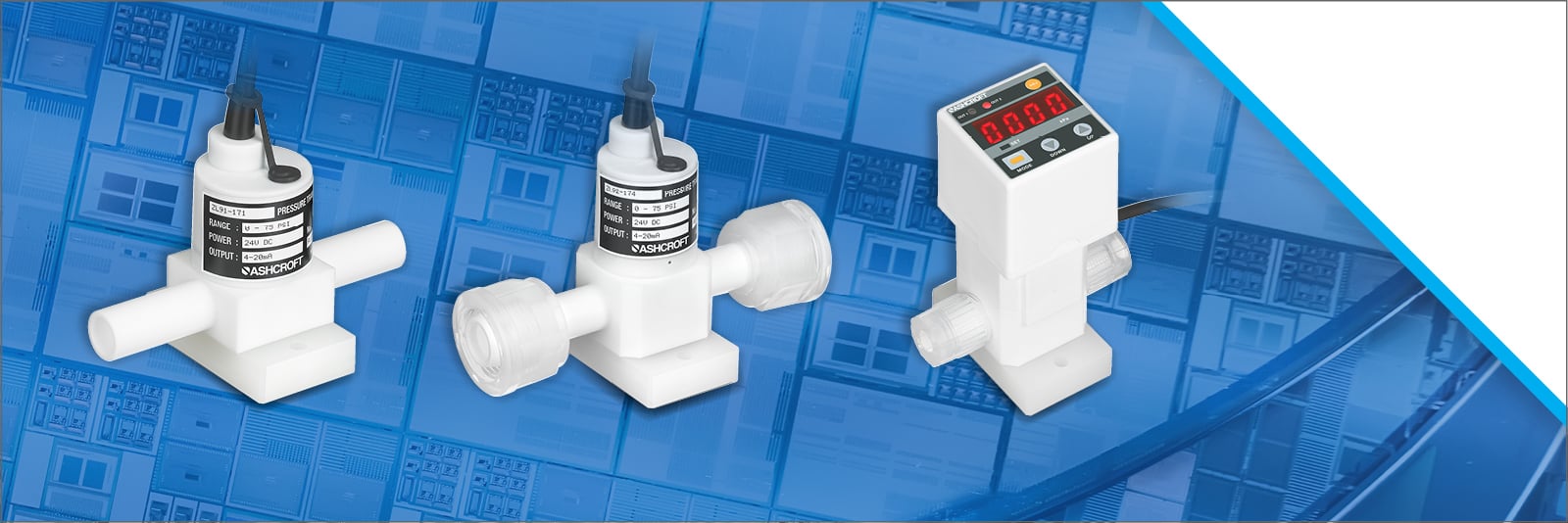
Fluoropolymers such as PTFE and PFA resist many aggressive chemicals and help reduce direct contact between process media and metallic wetted components. For example, the Ashcroft® HPT Anti-Corrosion Pressure Gauge uses PTFE and PFA wetted components and is designed for chemical delivery systems, wafer manufacturing, ultrapure water applications and plating processes.
Important selection considerations include:
- Chemical compatibility: Confirm that the wetted materials are suitable for the specific chemical and concentration.
- Contamination risks: Determine whether metal ion contamination could affect the process.
- Operating limitations: Evaluate pressure, temperature and the potential for chemical permeation.
Fluoropolymer construction does not guarantee compatibility with every chemical. The Ashcroft HPT is also not recommended for gas or high-temperature applications. For a closer look at this instrument, read the Ashcroft HPT pressure gauge review.
How do you choose the right pressure gauge for each semiconductor system?
Choosing the right pressure gauge starts with identifying the system, process media and measurement requirements. The following chart summarizes common applications and the instrument characteristics that may be appropriate.
Figure 1. Examples of Ashcroft pressure gauges used in semiconductor manufacturing systems
|
Semiconductor system |
Primary measurement considerations |
Ashcroft instrument example |
|
Plant utilities and compatible compressed air systems |
Reliable pressure indication, media compatibility and operating conditions |
|
|
High-purity gas delivery |
Cleanliness, leak integrity, wetted-material compatibility and connections |
|
|
Corrosive chemical delivery and ultrapure water |
Chemical resistance, contamination control and operating limitations |
These examples illustrate typical applications rather than universal requirements. Instrument selection must be based on the specific media, pressure range, temperature, cleanliness specifications and installation conditions.
Before making a final selection, ask:
- What is being measured? Identify the process media and confirm wetted-material compatibility.
- What contamination controls are necessary? Determine whether specialized cleaning, leak testing or nonmetallic wetted materials are required.
- What function does the instrument need to perform? Decide whether the application requires local pressure indication, a switching signal or both.
- Will the instrument meet the operating requirements? Check pressure range, accuracy, temperature limits and process connections.
Ready to learn more?
Semiconductor manufacturing involves different pressure measurement requirements across plant utilities, high-purity gas delivery and liquid processing systems. Understanding where each instrument is appropriate can help you select a gauge that supports reliable operation without introducing unnecessary complexity.
To learn more about selecting pressure instrumentation for your semiconductor applications, review our related resources or contact an Ashcroft product expert for assistance. In the meantime, download our guide.

Topics: