

Subscribe now and get the latest blog posts delivered straight to your inbox.
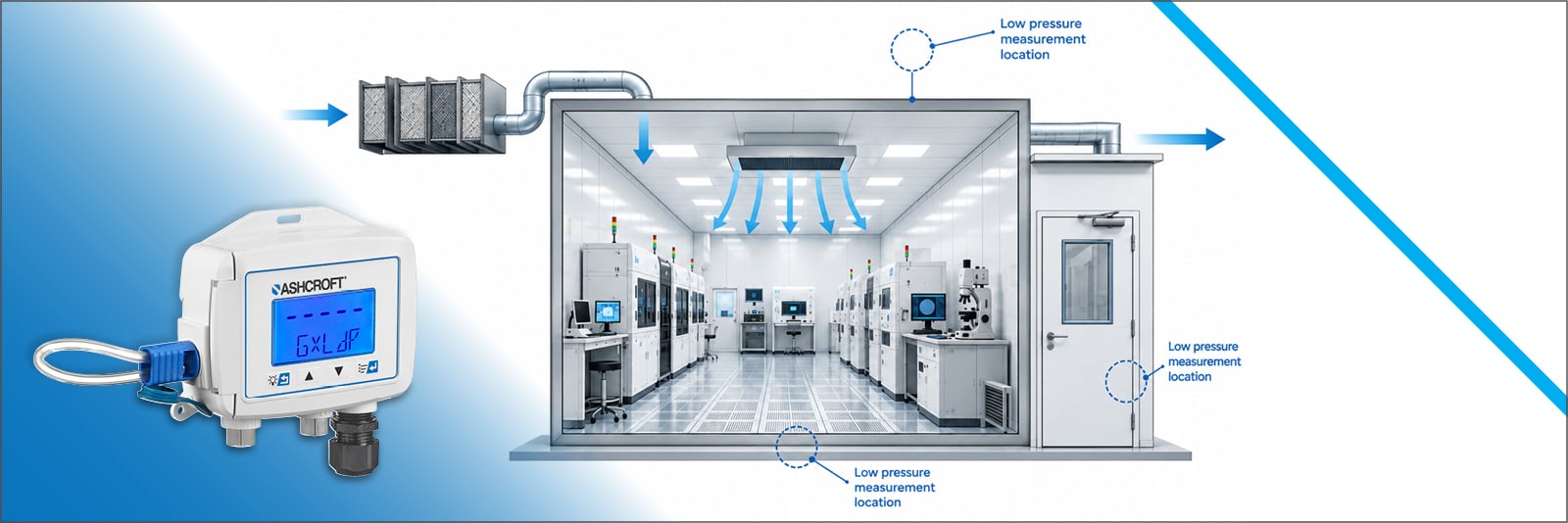
Air systems in semiconductor manufacturing are monitored using differential pressure instruments that measure airflow, filter condition, exhaust performance and pressure relationships between controlled spaces.
Maintaining the right airflow and room pressure is essential for controlling airborne particles in semiconductor cleanrooms. Small pressure changes can indicate a clogged filter, inadequate airflow, an exhaust issue or a loss of the positive pressure that helps prevent contaminants from entering a controlled area.
With decades of experience designing pressure instrumentation for controlled environments, Ashcroft helps semiconductor manufacturers and system designers evaluate measurement solutions for cleanroom air systems. Read this article to learn how differential pressure instruments support fan filter units, filtration, exhaust systems and cleanroom pressurization.
Why are air systems important in semiconductor manufacturing?
Air systems help maintain the controlled environment required for semiconductor manufacturing by filtering the air, managing ventilation and controlling airflow between spaces.
Proper air management supports several important functions:
- Particle control: Filtered air reduces airborne contaminants that could affect wafers, sensitive processes or manufacturing equipment. ISO 14644-1 provides the framework for classifying cleanroom air cleanliness based on airborne particle concentration.
- Airflow direction: Controlled pressure differences help move air from cleaner spaces toward less-controlled areas.
- Ventilation: Exhaust systems remove air from designated areas and help maintain the intended balance between supply and exhaust.
- Process consistency: Stable environmental conditions help reduce variations that could affect manufacturing quality or yield.
Although these systems operate at very low pressures, even a small change can affect airflow or indicate that part of the system needs attention.
How does differential pressure help evaluate semiconductor air systems?
Differential pressure transducers allow facility teams to compare the pressure at two locations within an air system. The measurement points depend on the application. They may be placed on opposite sides of a filter, between adjacent rooms or at selected locations in an air duct.
These measurements can help determine whether:
- Air is moving correctly: The reading can confirm that air is flowing in the intended direction between controlled spaces.
- A filter is becoming restricted: An increasing pressure difference across a filter may indicate particle buildup.
- A fan is performing as expected: Changes in pressure can reveal reduced fan output or changing system conditions.
- An exhaust system is operating properly: The measurement can help confirm airflow through ducts and ventilation equipment.
- Room pressure is being maintained: A differential pressure instrument can monitor the relationship between a cleanroom and an adjoining space.
Differential pressure is often expressed in inches of water column, or in. H₂O. Cleanroom pressure differences may be only a small fraction of an inch of water column, so the instrument must be designed for very low-pressure measurement.
How are fan filter units and filters monitored?
Fan filter units and filters are monitored by measuring the differential pressure associated with airflow and flow resistance.
Fan filter units, which are commonly called FFUs, combine a fan with a high-efficiency filter to supply clean air to the manufacturing space. Multiple units may be installed throughout the cleanroom ceiling to provide consistent filtered airflow.
How can differential pressure reveal fan performance?
Differential pressure can reveal fan performance by showing whether the unit is producing the expected airflow conditions. Depending on the system design, pressure may be measured across the fan or at selected locations within the air distribution system. Changes in the reading may indicate:
- Reduced fan performance: A lower-than-expected pressure difference may mean the fan is not producing the required airflow.
- Airflow restrictions: An unexpected reading can point to an obstruction or another condition limiting air movement.
- Damper position changes: A change in damper position can alter system resistance and affect the measured pressure.
- Inconsistent air delivery: Comparing measurements from different areas can help identify variations in air distribution.
The instrument signal may also be sent to a building management or control system, allowing facility teams to track trends and receive alerts when conditions move outside established limits.
How does differential pressure indicate filter condition?
Differential pressure indicates filter condition by measuring resistance to airflow across the filter. As particles accumulate, more pressure is required to maintain the same airflow. This causes the differential pressure across the filter to increase.
Tracking this measurement can help facility teams:
- Recognize developing restrictions: A gradual increase may indicate that the filter is loading with particles.
- Plan condition-based maintenance: Teams can use actual system performance to support filter replacement decisions instead of relying only on a fixed schedule.
- Identify sudden changes: An abrupt increase or decrease may indicate filter damage, leakage, improper installation or another system issue.
- Confirm replacement results: A change after service can help teams evaluate whether the new filter and related components are operating properly.
Fan speed, damper position and airflow demand can also influence the reading. Filter differential pressure should therefore be evaluated with other system information.
How is airflow monitored in exhaust and air volume systems?
Exhaust and air volume systems are monitored using differential pressure measurements to evaluate airflow through ducts and ventilation equipment. Semiconductor facilities use exhaust systems to remove air from process areas and maintain the intended balance between supply and exhaust. Too much or too little exhaust airflow can affect room pressure and overall environmental control.
One way to determine airflow is to measure the difference between static and total pressure at selected points in a duct. A flow element, such as a pitot tube, provides the pressure inputs for the differential pressure instrument.
The relationship between differential pressure and air velocity is nonlinear. This means a small pressure change at the lower end of the range may represent a meaningful change in airflow.
Monitoring exhaust and air volume can help teams:
- Confirm duct airflow: Measurements show whether air is moving through the duct as intended.
- Identify performance changes: A change may indicate an airflow restriction or reduced fan performance.
- Balance supply and exhaust: Pressure information can help facility teams maintain the intended relationship between incoming and outgoing air.
- Support system control: The instrument output can provide feedback to ventilation control systems.
The pressure range must be selected carefully. A range that is too broad may not provide enough resolution under normal conditions, while a range that is too narrow may not accommodate expected variations.
How is cleanroom pressurization measured?
Cleanroom pressurization is typically measured by comparing the pressure inside the cleanroom with the pressure in an adjacent space.
Semiconductor cleanrooms are generally maintained at a slightly higher pressure than surrounding, less-controlled areas. When a door opens, this positive pressure encourages air to move out of the cleanroom instead of allowing unfiltered air to enter.
Some facilities use several pressure-controlled zones, with cleaner areas maintained at higher relative pressures. Differential pressure instruments can track these relationships among cleanrooms, adjoining rooms and corridors.
Room pressure measurements allow facility teams to:
- Confirm airflow direction: Positive pressure helps air move toward the less-controlled space.
- Detect a loss of pressure: A low reading may indicate an open door, fan issue or airflow imbalance.
- Support automatic adjustments: The output signal can help a control system adjust fans, dampers or airflow volume.
- Review deviations: Recorded data allows facility teams to identify pressure trends and investigate changing conditions.
More pressure is not necessarily better. Excessive room pressure can make doors difficult to operate and increase airflow demands. The correct setpoint depends on the facility design and applicable cleanroom requirements.
Why is very low-pressure measurement challenging?
Very low-pressure measurement is challenging because minor environmental and installation conditions can have a noticeable effect on the reading. Important factors include:
- Temperature changes: Different temperatures can affect the density of air inside the pressure tubing and introduce measurement error.
- Tubing installation: Long runs, sharp bends, restrictions or leaks can affect how pressure reaches the instrument.
- Mounting orientation: Some low-pressure instruments must be installed in a specific position to maintain their stated performance.
- Vibration: Fans and other mechanical equipment can introduce vibration near the instrument or sensing lines.
- Zero drift: A small change in the zero point can be significant when the entire measurement range is very low.
- Air turbulence: Unstable airflow near a sensing point can produce fluctuating readings that do not represent overall system conditions.
Following the manufacturer’s installation guidance and locating sensing points carefully can help limit these effects.
What should you consider when selecting an instrument?
When selecting an instrument for a semiconductor air system, consider what will be measured, the expected pressure range and how the measurement will be used.
Key considerations include:
- Pressure range: Select a range that covers expected conditions while providing adequate resolution near the normal operating point.
- Accuracy and stability: Determine the required measurement tolerance and how much long-term drift the application can accept.
- Response time: Airflow control may require a faster response than basic filter-condition measurement.
- Measurement direction: Confirm whether the application measures pressure in one direction or must detect both positive and negative pressure.
- System integration: Make sure the output signal is compatible with the facility’s building management or control system.
- Local functionality: A display can simplify observation, while switch outputs may support alarms or equipment control.
- Service access: Consider how the instrument will be checked or calibrated after installation.
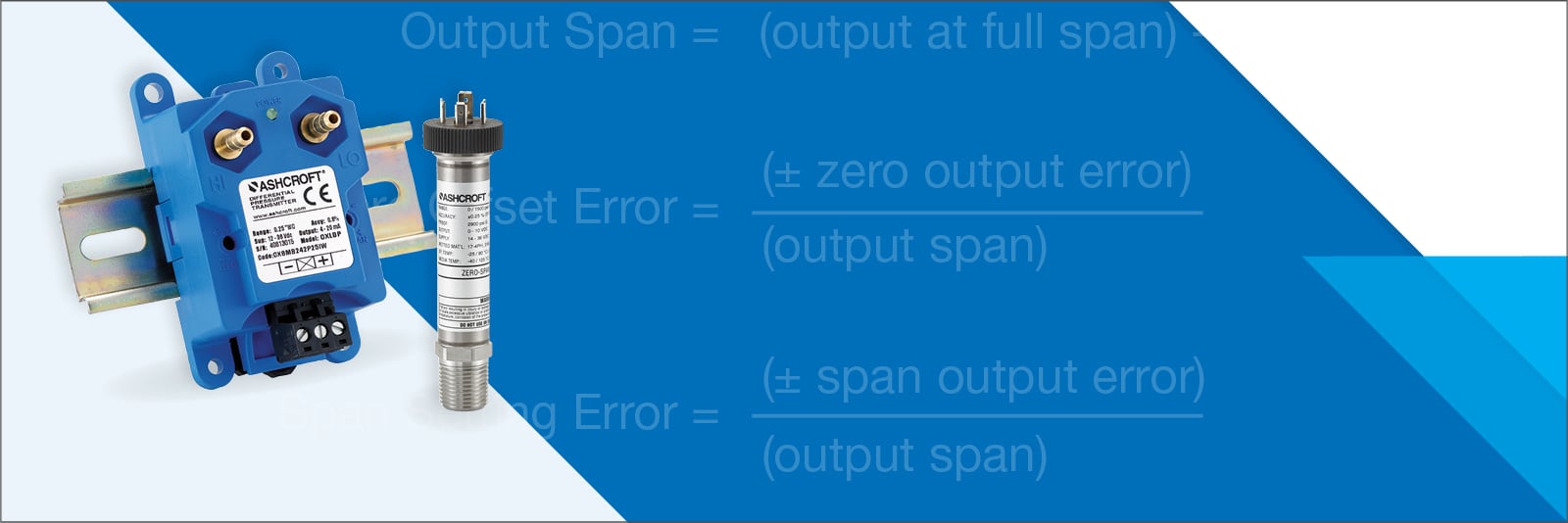
The Ashcroft® CXLdp, DXLdp and GXLdp differential pressure transducers are examples of low-pressure instruments that may be used for cleanroom pressurization, filter monitoring and airflow control. The appropriate instrument depends on the pressure range, required performance and system design.
Learn more about semiconductor pressure measurement
Air handling is one of several areas where pressure measurement supports semiconductor manufacturing. Pressure instruments may also be used throughout gas delivery, chemical distribution, ultrapure water and other facility and process systems.
To learn more about measurement instruments for semiconductor manufacturing, see the related articles below. If you have questions about your specific application, contact us to speak to a product expert.






.png?width=1600&height=534&name=choosing-pressure-switch-9factors_BLOG%20(1).png)