

Subscribe now and get the latest blog posts delivered straight to your inbox.

A test gauge is a high-accuracy pressure measurement instrument serving as a reference to verify the performance of other pressure devices, such as working gauges, pressure switches or transmitters. Over time, pressure gauges and sensors in process and industrial systems can drift due to wear, temperature changes, vibration or process conditions. Having a reliable reference helps ensure that your pressure reading can be trusted.
As a global leader in pressure and temperature instrumentation, Ashcroft supports accurate and traceable measurement across a wide range of industries. Read this article to learn about the different types of test gauges, how they differ from a working gauge, when you need to use one and why it is important for certain applications.
What's the difference between a test gauge and a working gauge
Although test gauges and working gauges may look similar, their roles are very different. A test gauge is a high-accuracy pressure measurement instrument used to verify the performance of other pressure devices installed in a process.
Test gauges are typically used temporarily during calibration checks, troubleshooting questionable readings and commissioning or validation activities. Because test gauges serve as reference standards, they are manufactured with tighter accuracy tolerances and more stable sensing elements than general-purpose pressure gauges.
Figure 1. Test Gauges vs. Working Gauges Comparison Table

Using a working gauge to check another working gauge defeats the purpose. A test gauge must always be more accurate than the instrument being tested.
The 4:1 Accuracy Rule
Industry guidance from organizations such as ASME recommends that the reference instrument used for calibration be at least four times more accurate than the device under test. This is often referred to as the 4:1 rule. For example, a working gauge with ±1% of full-scale accuracy should be verified using a test gauge accurate to ±0.25% of full scale or better
When Do You Need a Test Gauge?
Not every application requires the use of a test gauge, but there are many situations where one becomes essential.
1. Checking calibration of installed gauges
Over time, pressure instruments can drift due to:
- Mechanical wear
- Pressure cycling
- Temperature changes
- Shock or vibration
A test gauge allows technicians to compare the installed gauge reading against a known, more accurate reference (either in place or on a bench) without immediately sending the instrument to a calibration lab.
2. Preventive maintenance programs
Many facilities incorporate periodic pressure checks into preventive maintenance schedules. In these cases, test gauges confirm instruments are still within tolerance, identify early signs of drift and decide whether recalibration or replacement is necessary.
As a general rule of thumb, many pressure instruments are checked annually, though critical applications may require more frequent verification.
3. Commissioning and system validation
During startup or after maintenance, test gauges are commonly used to validate correct installation, confirm pressure points and verify control devices respond at the intended setpoints.
4. Investigating questionable readings
If operators suspect a pressure reading is incorrect due to process anomalies or conflicting indicators, a test gauge provides a reliable way to confirm whether the issue lies with the instrument or the process itself.
5. Meeting quality or regulatory requirements
Some quality systems, customer specifications or internal QA manuals explicitly require documented verification of pressure instruments. In these cases, a calibrated test gauge becomes a necessary tool for compliance.
What are some of the different types of test gauges?
Test gauges come in several forms, depending on accuracy requirements, environment and use case. To ensure a pressure gauge is calibrated correctly, two standards of calibration instruments are used to test the instrument: primary standards and secondary standards. Test instruments fall into one of these two categories.
Primary standards
A primary standard is a highly accurate reference that is not calibrated by other standards. It is defined through fundamental quantities such as length, mass and time, and is used to calibrate secondary standard instruments.
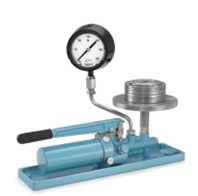
A common example of a primary pressure standard instrument is a deadweight tester. While not considered test gauges in the traditional sense, it’s worth noting that deadweight testers serve as primary pressure standards.
Deadweight testers generate pressure based on fundamental physical principles and are typically used to calibrate test gauges themselves in controlled laboratory environments. These instruments use calibrated weights applied over a known piston area to generate precise pressure values. Deadweight testers are well-suited for laboratory calibration and for establishing traceability.
Figure 2: Ashcroft® 1305D and 1305DH Deadweight Tester
Secondary Standards
Secondary standard instruments are calibrated against a primary standard, like the deadweight tester mentioned above, to ensure their accuracy. They serve as the reference instruments used to verify working gauges, transmitters and switches in both laboratory and field environments and must maintain a high level of precision.
In calibration terms, most test gauges are considered secondary standards, meaning they have been calibrated against a higher-accuracy primary standard and maintain traceability back to national standards like NIST.
Examples of secondary standard test instruments include:
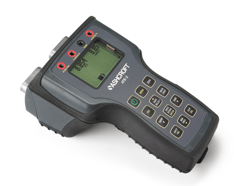
1. Handheld test instruments
These portable instruments, combined with a pressure reference, have electronic measurement capabilities. They are used when accurate, traceable calibration is required in the field or lab. Depending on the configuration, these multifunction devices can measure:
- Pressure
- Current or voltage
- Temperature
Handhelds support configuration and documentation functions and are especially useful for verifying pressure transmitters or smart instruments.
Figure 3. Ashcroft® ATE-2 Handheld Calibrator
2. Digital test gauges
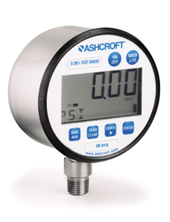
Digital test gauges, like Ashcroft® 2084, 2086 and 2089 instruments offer high accuracy and resolution for test and measurement work. Their total error band includes linearity, hysteresis, repeatability and temperature effects, helping to ensure stable and repeatable verification results.
These gauges are commonly used as secondary standards in both laboratory and field environments, especially where minimizing reading error is critical. Benefits of these instruments include:
- High accuracy and resolution
- Easy-to-read displays
- Multiple engineering units available
Figure 4. Ashcroft® 2084 Test Gauge
3. Analog test gauge
Analog test gauges, including the Ashcroft® 1082 Test Gauge, and the Ashcroft®1084 Test Gauge, are used to inspect, test and validate pressure at key installation points. The 1082 is often selected where durability and long-term performance are critical, while the 1084 offers a more compact solution when panel space or mounting envelope is limited.
These test gauges feature tighter tolerances, refined movement mechanisms and clear dial graduations for precise readings. Examples range from traditional precision test gauges to compact models used for quick spot checks. They are often used in calibration and test laboratories, maintenance shops and field verification where simplicity and ruggedness are preferred.
Figure 5. Ashcroft® 1082 Test Gauge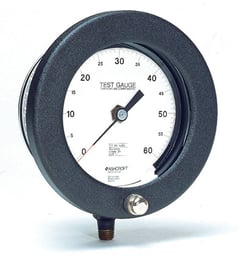
Key Takeaways
- A test gauge is a high-accuracy reference instrument used to verify other pressure devices
- Test gauges are typically secondary standards calibrated against primary references
- They are essential for calibration checks, preventive maintenance, commissioning and troubleshooting
- The 4:1 accuracy rule helps ensure meaningful verification results
- Both analog and digital test gauges have a place, depending on accuracy needs and the application
Ready to learn more?
Understanding when and how to use a test gauge helps protect process reliability, safety and measurement integrity without overcomplicating your instrument maintenance strategy. If you have more questions, read some of the related articles below or contact us to speak with a product expert.