

Subscribe now and get the latest blog posts delivered straight to your inbox.
Environmental approvals such as Restriction of Hazardous Substances (RoHS), Registration, Evaluation, Authorization and Restriction of Chemicals (REACH) and others are required based on where your pressure instruments are sold, how they are used, and whether they include electronic components.
Many of these approvals are often grouped together as “certifications,” but they are not the same thing. Each one applies under different conditions and serves a different purpose.
Whether you are designing equipment for global markets, supplying systems to regulated industries or meeting internal environmental, social and governance (ESG) goals, understanding these requirements is critical. Read this article to learn why they exist and determine which ones apply to your specific application.
Why does environmental compliance matter for pressure instruments?
Environmental compliance matters because it directly affects where your equipment can be sold, how it can be used and whether it meets customer and regulatory expectations. These requirements are typically driven by a combination of regional regulations, application-specific rules and customer standards:
-
Market access, particularly in the European Union (EU) and California
-
Application requirements such as potable water systems
-
Original equipment manufacturer (OEM) specifications
-
Environmental, social, and governance (ESG) reporting
Unlike performance certifications, these requirements focus on material content, chemical restrictions and supply chain transparency.
When is Restriction of Hazardous Substances (RoHS) required for pressure instruments?
Restriction of Hazardous Substances (RoHS) is required when a pressure instrument contains electrical or electronic components and is sold into markets that enforce the directive. The regulation limits the use of hazardous materials such as lead, mercury and cadmium in electrical and electronic equipment.
RoHS most commonly affects:
- Transducers and transmitters
- Pressure switches
-
Digital gauges and electronic instrumentation
Mechanical gauges and other purely mechanical devices are generally outside the scope because they do not contain electrical components.
When does Registration, Evaluation, Authorization and Restriction of Chemicals (REACH) apply?
Registration, Evaluation, Authorization and Restriction of Chemicals (REACH) covers nearly all pressure instruments, whether mechanical or electronic. It focuses on tracking and communicating chemical substances used in those products.
REACH affects:
It also addresses Substances of Very High Concern (SVHC).
Are conflict minerals requirements needed for pressure instruments?
Conflict minerals requirements become relevant when your product contains materials such as tin, tungsten, tantalum, or gold and is part of a supply chain that requires sourcing transparency. They are driven by United States regulations and corporate reporting expectations related to material sourcing.
These requirements are most common when you are supplying to large OEMs or supporting publicly-traded companies and ESG reporting requirements.
When does the Safe Drinking Water Act (SDWA) apply to pressure instruments?
The Safe Drinking Water Act (SDWA) becomes relevant when pressure instruments are used in potable water systems where wetted components come into contact with drinking water. The regulation limits lead content to a weighted average of 0.25 percent in wetted materials.
SDWA is required for applications such as:
-
Municipal water systems
-
Drinking water distribution
-
Plumbing-related OEM equipment
For more information on requirements for potable drinking water, read Understanding NSF 61 Approvals for Pressure Instruments.
When does California Proposition 65 apply?
California Proposition 65 applies when products sold into California contain one or more chemicals listed under above established "safe harbor" levels.
For pressure instruments, Proposition 65 is most likely to apply when wetted or external materials include certain alloys, surface treatments, elastomers or other components that may contain listed substances above those thresholds.
It is important to note that Proposition 65 is a product warning and labeling requirement, not a safety or performance certification. It does not “approve” or “disqualify” a pressure instrument for use. Instead, it requires that clear warnings be provided to end users when the product’s chemical composition meets the criteria set by the regulation.
Even if the instrument meets all functional and performance specifications, the presence of these materials can still trigger a labeling requirement.
Which environmental approval do you actually need?
The environmental approvals you need are determined by your market, application and instrument type.
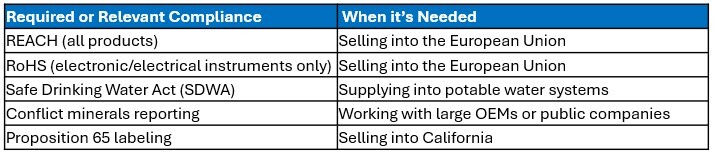
The table below provides a quick way to align your situation with the relevant requirement.
Figure 1: Environmental Approvals Chart
How does Ashcroft support environmental compliance?
Ashcroft supports environmental compliance by providing traceability, documentation and application-based guidance across its product offering. These depend on how and where a product is used, support is focused on helping customers comply with environmental requirements.
This includes:
-
Screening products for restricted substances
-
Maintaining supply chain traceability
-
Providing documentation for RoHS, REACH and conflict minerals
-
Supporting application-specific requirements such as SDWA
-
Assisting customers in determining applicable requirements
For additional information, visit the Ashcroft Product Stewardship page.
Ready to learn more?
Now that you have an overview of environmental approvals for pressure instruments, you can better determine which requirements apply to your application. If you have more questions, contact us to speak to a product expert. In the meantime, take a look at the additional articles and resources below.


.png?width=1600&height=534&name=choosing-pressure-switch-9factors_BLOG%20(1).png)