

Subscribe now and get the latest blog posts delivered straight to your inbox.
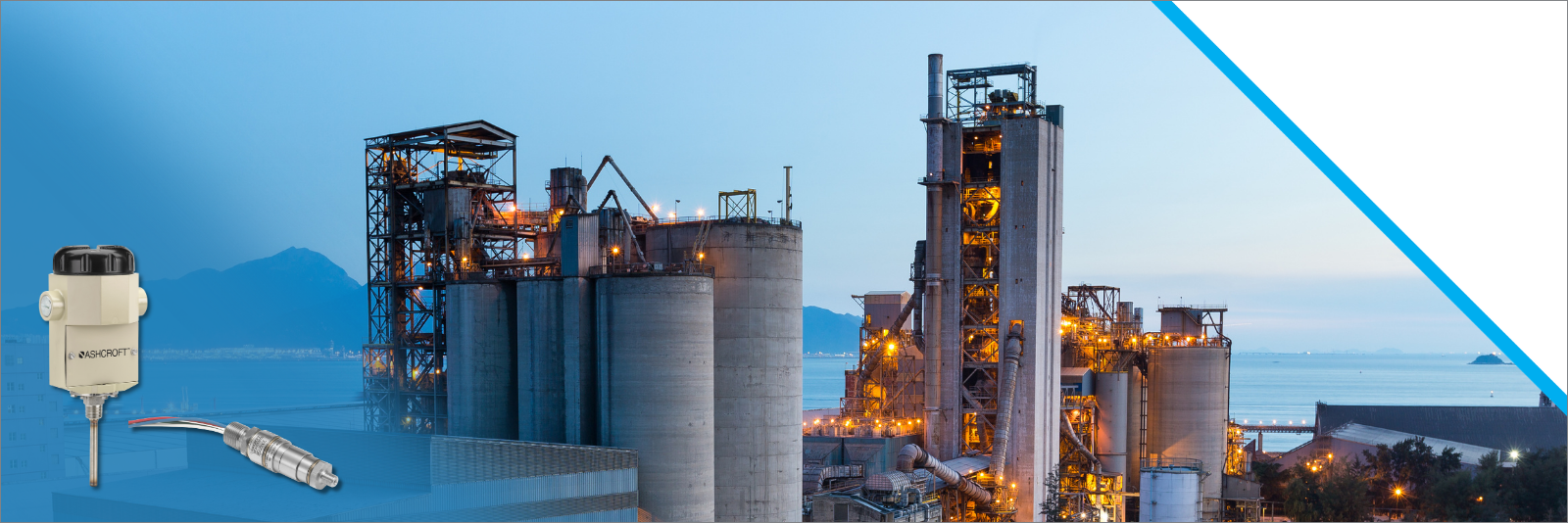
Pressure and temperature switches help protect chemical processes by responding the moment a pressure or temperature setpoint is crossed. They can trigger an alarm, start or stop equipment, or automatically shut down a process before reactors, pumps, or storage tanks operate outside safe limits.
Ashcroft is a recognized leader in pressure and temperature instrumentation. For decades, we have helped customers understand the key factors to consider when selecting instruments for demanding chemical processing applications.
Read this article to learn where you can find pressure and temperature switches in chemical processes and what to consider when specifying one for your application.
Where are pressure switches used in chemical processes?
Pressure switches show up throughout chemical and petrochemical operations, typically performing one of two jobs: alerting an operator that a variable has moved out of range, or automatically starting, stopping, or interlocking equipment. Here are some specific examples of where they are used:
- Pumps and compressors. A low-pressure switch shuts down a pump before it runs dry or cavitates, protecting equipment in agricultural chemical, biochemical, and ethanol processes where consistent flow is critical to product quality.
- Filters and strainers. A pressure switch can monitor the pressure drop across a filter or strainer and alert an operator when it needs to be cleaned or replaced, a technique used in gas separation and fractional distillation.
- Storage tanks. Pressure switches guard bulk chemical, lubricant, and gas storage tanks against overpressure or vacuum conditions.
Where are temperatures switches used in chemical processes?
Temperature switches alert operators when the system temperature has moved out of range and automatically starts, stops, or interlocks equipment. Examples of where they're used in chemical plants include:
- Batch reactors and exothermic reaction monitors. A temperature switch trips an alarm or initiates emergency cooling when a reaction exceeds a safe threshold, a common safeguard in specialty and agricultural chemical batch processes.
- Fermentation and process heating. Temperature switches monitor cooking, fermenting, and distillation stages in ethanol and biochemical operations.
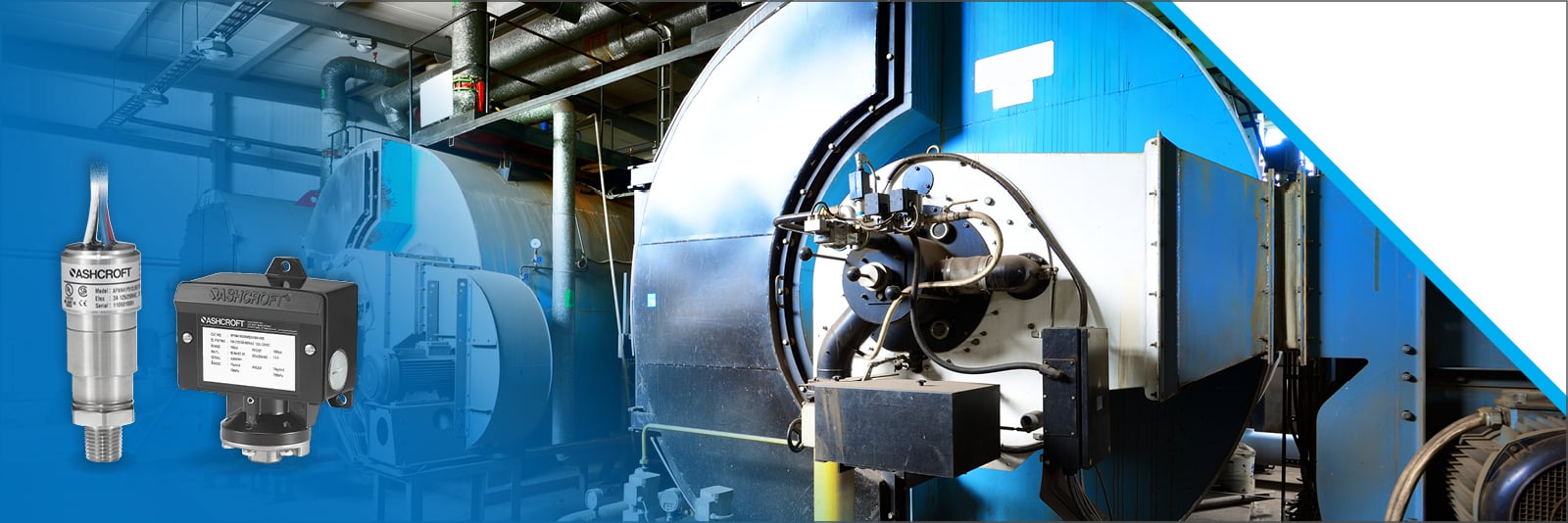
- Burners and boilers. Temperature switches protect the burners and boilers that supply heat to plastics and polymer production lines, shutting down the heat source before it exceeds a safe limit.
Figure 1: Common pressure and temperature switch applications
| Chemical application | Pressure switch | Temperature switch |
|---|---|---|
| Pumps and compressors | Low-pressure protection | — |
| Filters and strainers | Differential pressure monitoring | — |
| Storage tanks | Overpressure or vacuum protection | — |
| Batch reactors | Pressure alarm/control | High-temperature alarm/control |
| Process heating | — | Temperature alarm/control |
| Boilers and burners | Pressure interlock/control | Temperature interlock/control |
Do chemical applications require switches to have special housing and certification ratings?
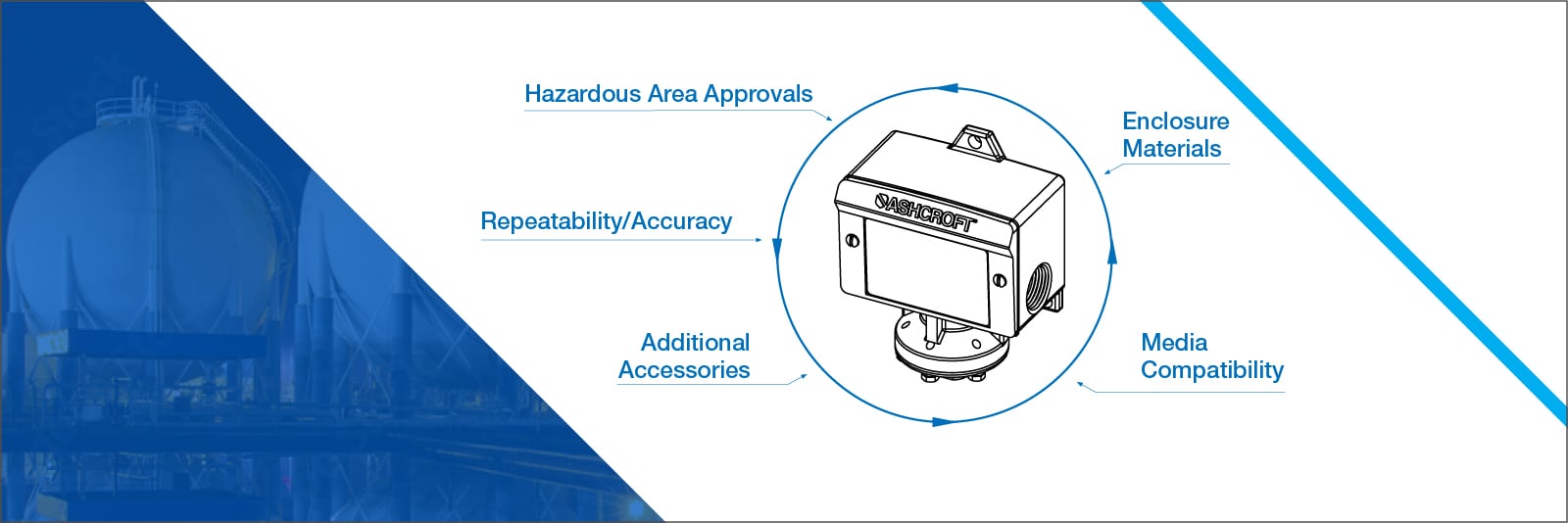
Chemical applications may require different enclosure and certification ratings depending on where the switch is installed and the conditions it will encounter. For example:
-
NEMA 4X provides protection against conditions such as windblown dust, rain, and hose-directed water.
-
NEMA 7 covers Class I locations where flammable gases or vapors may be present, while NEMA 9 covers Class II locations where combustible dust may be a concern. Both classifications can be relevant in chemical and petrochemical processing areas. Learn more about NEMA 4X/7/9.
-
Safety Integrity Level (SIL) certification may be required when the switch is part of a safety instrumented function. In these applications, SIL documentation helps verify that the device is suitable for the required level of risk reduction. Learn more about SIL for switches.
The appropriate enclosure and approvals therefore depend on the application rather than simply whether the instrument is being used in a chemical plant.
How do you protect switches from corrosive process media?
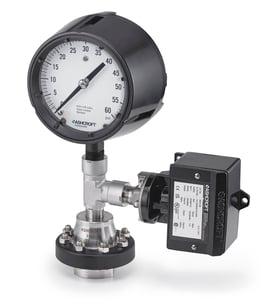
You can protect a pressure or temperature switch from corrosive process media by matching the wetted diaphragm material to the process and adding a diaphragm seal to isolate the pressure switch when no compatible material is available. For a temperature switch, you would use a thermowell.
Corrosion is one of the leading causes of instrument failure in chemical service, and a switch's acuator system is just as vulnerable as a gauge's Bourdon tube to pitting, crevice corrosion, and stress corrosion cracking.
Before choosing a diaphragm seal, you need to ensure that the wetted material of the seal is compatible with your process. You can do this by using the online Ashcroft® Material Selection Tool.
Figure 2. A diaphragm seal and pressure switch assembly
How do pressure and temperature switches compare for chemical service?
The appropriate switch depends on the variable being measured, pressure or temperature range, environmental conditions, hazardous location requirements, and the type of alarm or control function required.
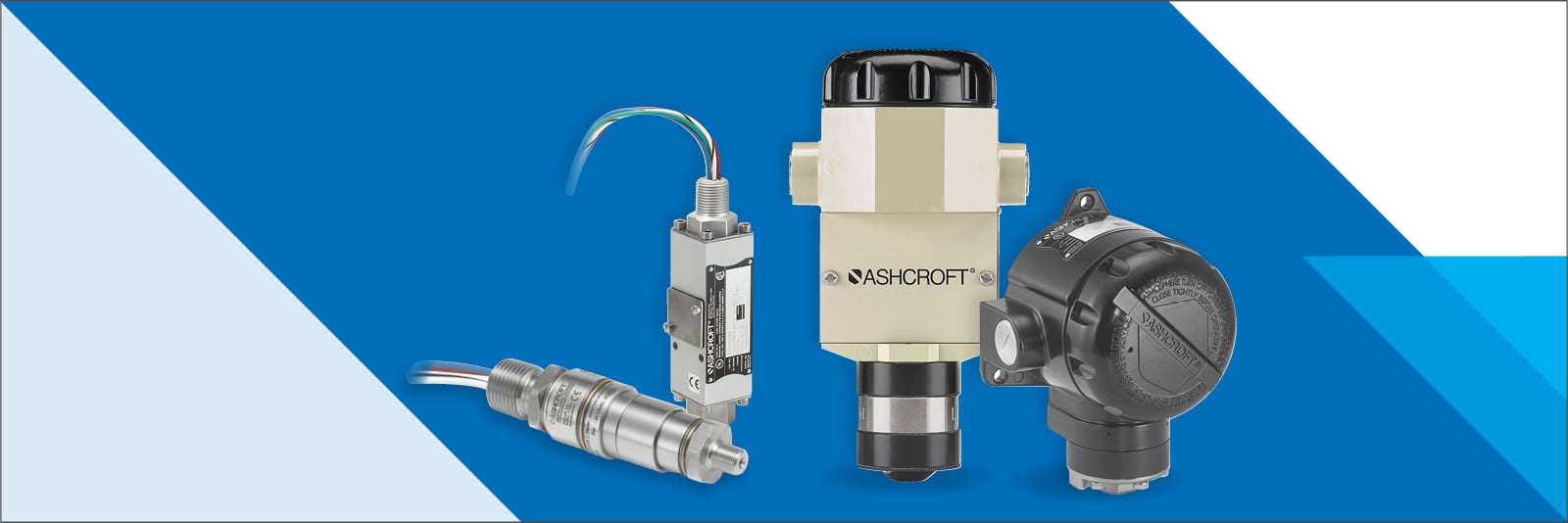
The following Ashcroft switches are examples of several configurations that can be used in chemical and petrochemical applications.
Explosion-proof miniature pressure switch
A compact pressure switch can provide alarm and control functions where space is limited and hazardous location protection is required.
Example: Ashcroft® A-Series Explosion Proof Miniature Pressure Switch
Range: Vacuum to 15,000 psi
Enclosure: NEMA 4X, 7, 9, IP67
Typical role: Pressure alarm and control in hazardous chemical process areas
Explosion-proof pressure and differential pressure switch
Pressure and differential pressure switches can provide alarm and control functions for applications ranging from process pressure to differential pressure measurements.
Example: Ashcroft® B-Series B7 and D7
Range: B7, vacuum to 3,000 psi; D7, 30 in. H₂O differential through 600 psid
Enclosure: NEMA 7/9, IP66
Typical role: Pressure or differential pressure alarm and control in hazardous locations
Single-setpoint temperature switch
A single-setpoint temperature switch can trigger an alarm or control action when process temperature reaches a predetermined point.
Example: Ashcroft® T7 Explosion Proof Temperature Switch
Range: -40 °F to 750 °F (-40 °C to 400 °C)
Enclosure: NEMA 7/9, IP66
Typical role: Temperature alarm and control in hazardous process areas
Dual-setpoint temperature switch
A dual-setpoint temperature switch provides two independently adjustable setpoints, allowing different actions to occur at different temperatures.
Example: Ashcroft® PT-Series NEMA 7/9 Explosion Proof Temperature Switch
Range: Model-dependent ranges from -40 °F to 60 °F through 500 °F to 750 °F
Enclosure: NEMA 7/9, IP66
Typical role: Applications that require staged temperature responses, such as an alarm followed by shutdown
Key takeaways
- Pressure switches respond to process pressure. They trip a mechanical microswitch at a setpoint to open or close an electrical circuit, while temperature switches perform a similar control function in response to temperature.
- Both instruments can support alarm and control functions. They can alert an operator when a variable moves out of range and initiate actions such as starting, stopping, or shutting down equipment.
- Consider the specific application. Pressure or temperature range, setpoint requirements, process media, environmental conditions, and hazardous location classifications can all affect switch selection.
- Material compatibility matters. Wetted materials should be compatible with the process media, and a diaphragm seal can provide additional isolation when needed.
- Enclosure and hazardous location requirements matter. The appropriate protection depends on where the switch will be installed, and the conditions present in that area.
- Setpoint configuration affects the control strategy. Single- and dual-setpoint switches can support different alarm, control, and shutdown requirements.
Ready to learn more?
Pressure and temperature switches are just one part of selecting instrumentation for demanding chemical and petrochemical processes. To learn more, check out the related resources below or contact an Ashcroft product expert to get your questions answered.
In the meantime, download our Chemical & Petrochemical Applications Guide to learn more about common applications, key selection considerations, and pressure and temperature measurement solutions for harsh chemical environments.



.png?width=1600&height=534&name=choosing-pressure-switch-9factors_BLOG%20(1).png)