

Subscribe now and get the latest blog posts delivered straight to your inbox.
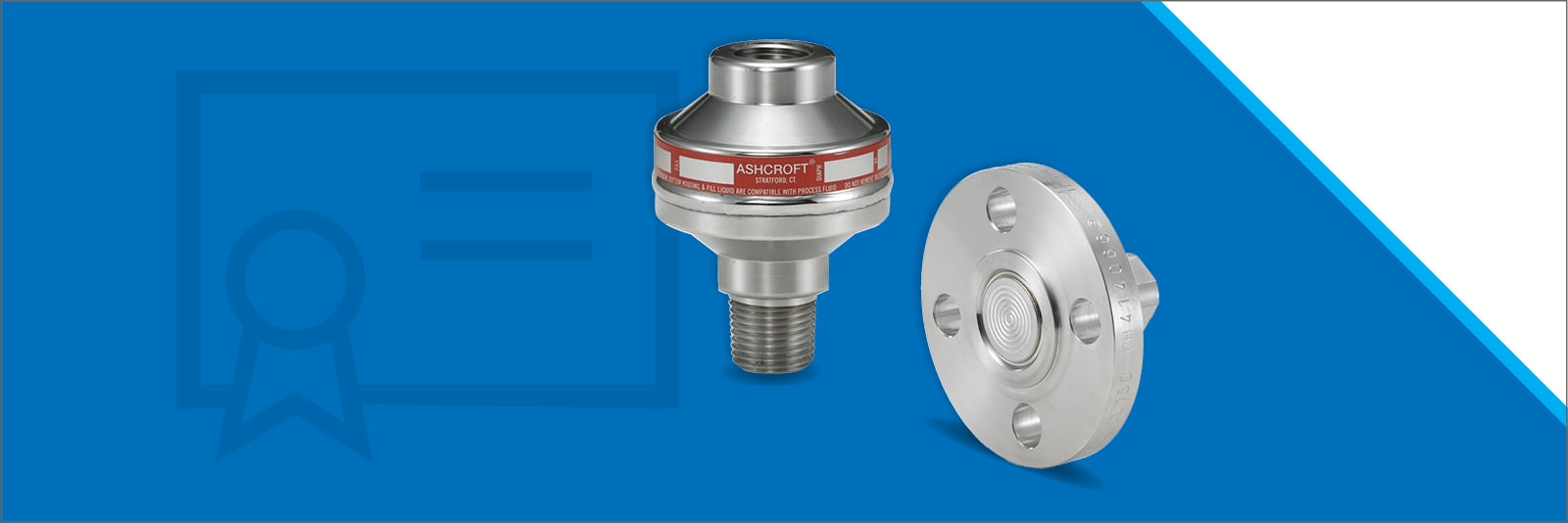
Diaphragm seal assemblies are available with a range of certifications that verify instrument construction and performance, including accuracy and repeatability, leak integrity and material composition as it relates to process compatibility. Because sensing elements often represent the thinnest physical barrier between process media and the atmosphere, these certifications provide documented assurance that an assembly is properly designed, manufactured, tested and configured for its intended application.
As a leading manufacturer of pressure and temperature instrumentation, Ashcroft supports engineers, quality teams and inspectors by providing the appropriate level of documentation to reduce risk, support compliance and avoid unnecessary complexity or cost.
In this article, you’ll learn about the most common types of diaphragm seal certifications, what each one confirms (and what it does not) and how adding a diaphragm seal to a pressure instrument introduces additional documentation requirements compared to using a standalone pressure instrument.
How are diaphragm seal certifications categorized?
Diaphragm seal certifications typically fall into one of the following categories:
- Conformance and quality assurance. Confirms the assembly meets published specifications at the time of shipment
- Calibration and performance verification. Documents the accuracy and repeatability of the pressure instrument
- Leak integrity and pressure testing. Verifies the assembly can safely contain pressure without leakage
- Material validation and traceability. Confirms material composition for compatibility and compliance
- Industry- or application-specific compliance. Addresses regulatory or end-use documentation requirements
Some certifications apply to individual components, while others are only meaningful when applied to the full assembly system. Each of these certification categories serves a different purpose and is described in more detail below.
What is a Certificate of Conformance (COC)?
A Certificate of Conformance confirms that the diaphragm seal assembly meets the manufacturer’s published specifications at the time of shipment.
Every diaphragm seal assembly shipped by Ashcroft includes a COC as a standard quality document issued by the quality department, verifying:
- The product was manufactured to approved drawings and specifications
- Required inspections were completed
- The configuration matches the customer’s order
In some cases, customers request a customized COC to include:
- Purchase order or tag references
- Customer-specific acceptance language
- Additional compliance statements
Although a COC does not include measured test data, it does provide baseline assurance that the product conforms to documented requirements. Additional certifications are often required to document performance, pressure integrity, or material traceability.
What does a calibration certificate verify for a diaphragm seal assembly?
A calibration certificate documents the accuracy and repeatability of a pressure instrument at the time it was tested.
All Ashcroft pressure instruments — including gauges, transmitters, transducers, and switches — are calibrated as part of standard production. A formal calibration certificate records actual test data showing how the instrument performed during verification.
How calibration is documented by instrument type
For pressure gauges, transmitters and transducers, readings are captured at multiple points along the pressure range and compared to the allowable tolerance.
For pressure switches, set point repeatability is verified, and reset points are typically documented.
How diaphragm seals influence calibration
When a diaphragm seal is added, the pressure instrument becomes part of a mechanical system that includes the diaphragm, fill fluid, and (when applicable) a capillary and/or other accessories. These elements can influence system performance and may slightly degrade accuracy compared to a standalone instrument.
Limitations of calibration certificates
Calibration certificates reflect performance only at the time and conditions of test. After shipment and installation, several factors can affect readings:
- Orientation changes (ASME B40.100 refers to this as position error)
- Temperature differences between calibration and operating conditions
- Mechanical effects introduced by diaphragm seals
- Shock effects from shipping and handling
These effects do not invalidate the original calibration certificate. Instead, they reflect real-world installation and operating conditions.
Accuracy selection
For standard process applications, a reasonable mechanical gauge accuracy is ASME B40.100 Grade 2A (±0.5%). Lower pressure spans (typically below 100 psi) are more sensitive to environmental and installation effects, making proper instrument selection and calibration orientation especially important.
What certifications address leak integrity and pressure limits?
Leak integrity certifications verify that a diaphragm seal assembly can safely contain pressure during normal operation and potential overpressure conditions.
The most common certification in this category is hydrostatic pressure testing, which documents the application of pressure above normal operating levels to confirm mechanical integrity.
Hydrostatic testing for diaphragm seal assemblies
- Must be performed on the fully assembled and properly filled system to prevent diaphragm rupture during overpressure testing
- Verifies the integrity of welds, joints, and pressure-containing components
When assemblies are hydrotested, the test pressure is based on the lowest maximum allowable working pressure (MAWP) of any component in the assembly.
Additional integrity-related testing
- Dye penetrant testing to verify weld quality
- Other inspection methods for critical safety applications
These certifications are typically required where leakage could pose safety, environmental, or operational risk.
What material documentation is required for diaphragm seal assemblies?
Material certifications verify that wetted and pressure boundary components are made from materials suitable for the intended process conditions. Material validation is often driven by compatibility with process media, corrosion resistance, or regulatory requirements.
Wetted vs pressure boundary components
Understanding the difference between wetted and pressure boundary components helps clarify which parts require material documentation and traceability.
- Wetted components: Parts in direct contact with process media
- Diaphragm
- Lower housing
- Gasket (when applicable)
- Pressure boundary components: Parts exposed to pressure but not necessarily wetted
For example:
- A mechanical pressure gauge installed directly into piping has pressure boundary components that are also wetted
- When installed on a diaphragm seal, the gauge’s socket, bourdon tube and tip are pressure boundary components but not wetted, while the diaphragm and lower housing are both wetted and pressure boundary
Material Test Reports (MTRs)
Ashcroft offers MTRs per EN 10204:
2.2 (“Typical”) — Confirms material compliance using representative supplier documentation
3.1 (“Actual”) — Provides traceability to a specific material heat and point of melt
Material Test Reports (MTRs)
Material Test Reports provide documented confirmation that metallic components conform to specified material requirements. Ashcroft offers MTRs according to EN 10204, including:
- 2.2 (“Typical”) Confirms material compliance using representative supplier documentation
- 3.1 (“Actual”) Provides documented traceability for a specific material via a serialized "heat" number and tracing the actual material's point of melt
Practical challenges with 3.1 traceability
While 3.1 material traceability offers the highest level of documentation, it can present practical challenges depending on component design and manufacturing processes.
Common challenges include:
- Components that cannot be physically etched with heat numbers
- Interchangeable components, such as capsule-style diaphragms, that introduce traceability risks
- Batch processes, including gold plating, that make melt-level documentation impractical
- Discovery of required MTR post shipment
Certain products, including Ashcroft's 510/511 and DF diaphragm seals, are serialized as standard, allowing 3.1 documentation to be provided even after shipment. Because they are all welded components, heat numbers for the wetted components can be etched on the side of the seal.
Positive Material Identification (PMI)
Positive Material Identification uses analytical equipment to verify actual material composition by element and percentage. PMI is especially useful when:
- Batch processes limit traceability
- Documentation is required after manufacturing
- Using material that may not have traceable documentation
PMI does require physical access to the material, which may not be possible once some diaphragm seals are fully assembled.
What industry or application-specific certifications may be required?
Industry or application-specific certifications address requirements tied to regulatory, hygienic, environmental, or safety standards. Examples include:
- Sanitary applications requiring surface finish documentation
- Semiconductor processes requiring cleanliness certification
- Drinking water applications requiring lead content or chemical leaching compliance
- Environmental compliance supporting sustainability initiatives
These certifications are driven by end-use requirements and may apply to the diaphragm seal, the pressure instrument, or the complete assembly.
Ready to learn more?
Now you know how the level of certification required for diaphragm seal assemblies can vary significantly depending on process conditions, regulatory requirements and risk tolerance in a wide range of critical applications.
Contact us if you need help identifying which certifications are appropriate for your diaphragm seal assembly and ensuring the documentation aligns with your operational and compliance needs.
You can also access related articles and resources below for additional reference. In the meantime, download our guide for help choosing the best instrument assembly for your application. ocumentation is required after manufacturing
PMI does require physical access to the material, which may not be possible once some diaphragm seals are fully assembled.
What industry- or application-specific certifications may be required?
Industry- or application-specific certifications address requirements tied to regulatory, hygienic, environmental, or safety standards.
Examples include:
Sanitary applications requiring surface finish documentation
Semiconductor processes requiring cleanliness certification
Drinking water applications requiring lead content or chemical leaching compliance
Environmental compliance supporting sustainability initiatives
These certifications are driven by end-use requirements and may apply to the diaphragm seal, the pressure instrument, or the complete assembly.
Closing guidance
Diaphragm seal assemblies are used in a wide range of critical applications, and the level of certification required can vary significantly depending on process conditions, regulatory requirements, and risk tolerance.
Ashcroft’s application engineers and quality teams can help identify which certifications are appropriate for your diaphragm seal assembly and ensure the documentation aligns with your operational and compliance needs.