

By:
Steve St. Hilaire
Director of Electronic Product Sales Support
Published on:
May 11th, 2026
Topics:
Subscribe now and get the latest blog posts delivered straight to your inbox.
By:
Steve St. Hilaire
Director of Electronic Product Sales Support
Published on:
May 11th, 2026
Topics:
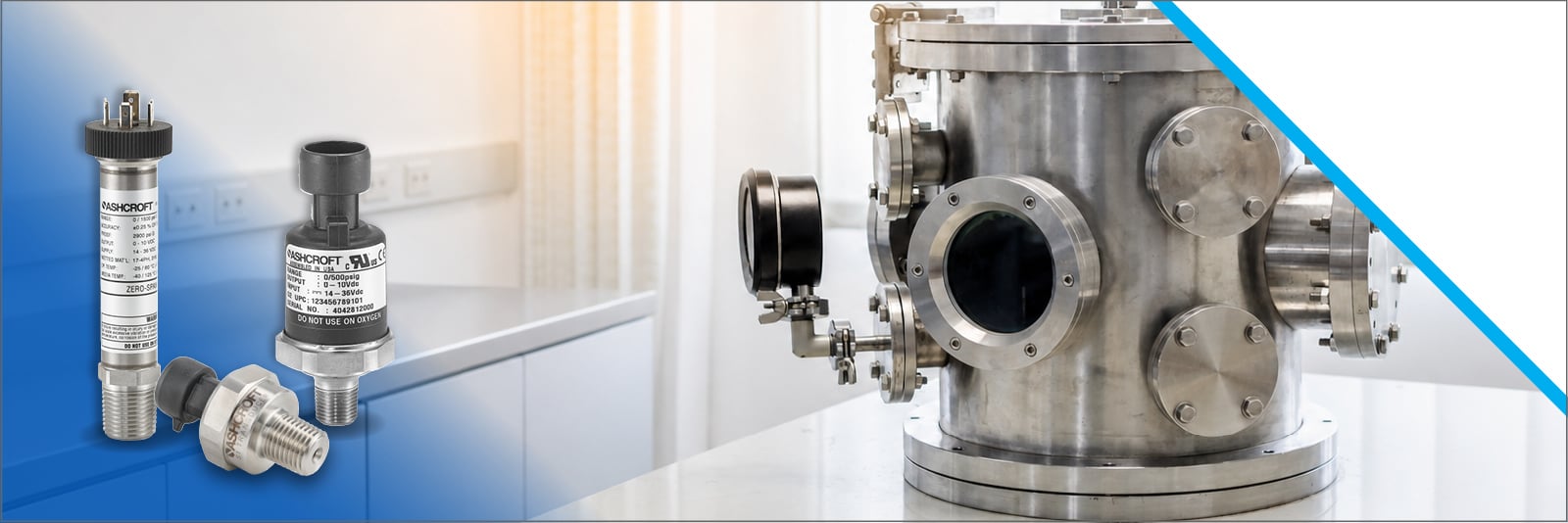
Selecting a pressure transducer for a negative pressure system requires choosing an instrument that can handle a vacuum or compound pressure range, has wetted materials compatible with the process media, and provides the accuracy and resolution to meet the requirements of the application.
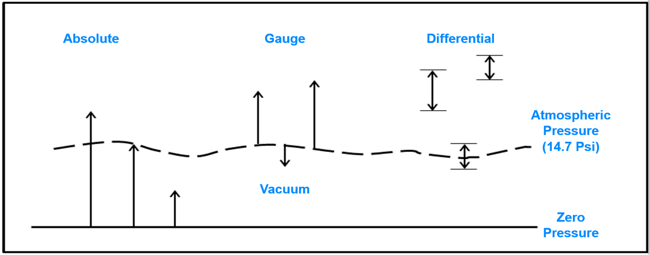
Transducers can be ranged depending on whether you need to measure relative vacuum to atmospheric pressure (gauge), a true zero-referenced reading (absolute), or a range that spans both positive and negative pressure (compound).
Read this article to learn what makes negative pressure measurement unique, which transducer specifications matter most, and how to match the right sensor to your application.
What is negative pressure, and how does it affect transducer selection?
Negative pressure, also called vacuum, refers to any pressure below atmospheric pressure. At atmospheric pressure, the reference is 14.7 psi. Generally, this means the system is pulling rather than pushing to draw fluid, gas, or air inward instead of forcing it outward.
From a measurement standpoint, this matters because not all pressure sensors are designed to handle negative pressure.
-
A standard pressure sensor reads pressure relative to the atmosphere, with zero at atmospheric pressure and positive values above it.
-
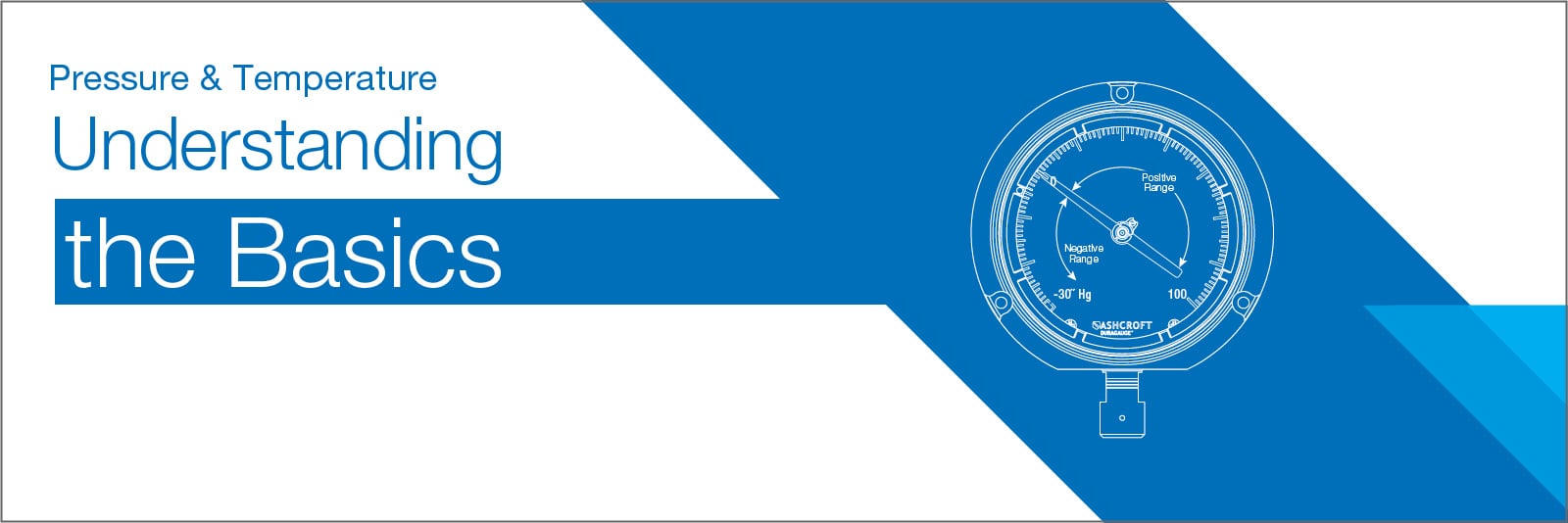
In a negative pressure system, the sensor must be capable of reading below atmospheric pressure. This is done by selecting either a compound or a vacuum sensing range.
Figure 1. Types of pressure sensing ranges
Choosing the wrong sensor type for a negative pressure application can result in inaccurate output readings or possible sensor damage. That's why understanding the pressure requirement of your application is the critical first step before evaluating any other specification.
What pressure range should you select for a vacuum application?
The first decision in sensor selection is determining which pressure reference is appropriate for your system:
-
Gauge and compound measure pressure relative to local atmospheric pressure, which is designated as 14.7 psi. An instrument with a compound range can read both below and above atmospheric pressure.
For example, a range of VAC to 100 psig covers full vacuum on the negative side of atmospheric pressure and pressure on the positive side above atmospheric pressure up to 100 psi. This is the most common choice for systems that cycle between vacuum and positive pressure, such as compressors or HVAC systems. -
Absolute measures pressure relative to a perfect vacuum (zero pressure), not the atmosphere. This is the preferred choice when atmospheric variation could affect measurement accuracy, which is common in laboratory, altitude-sensitive, or barometric applications.
What level of accuracy and repeatability do negative pressure systems require?
Accuracy requirements depend on the application. A vacuum conveying system monitoring when suction is present has different needs than a medical device or laboratory instrument requiring precise, repeatable low-pressure readings.
One challenge specific to negative pressure measurement is the limited span available. Vacuum is bounded at the low end because you cannot get a pressure lower than absolute zero. A sensor measuring vacuum only has a 14.7 psi span. This means small errors in the vacuum range represent a larger percentage of the total reading, making the accuracy of the instrument one of the more critical considerations.
When evaluating your sensor needs for vacuum applications, consider:
-
Accuracy. Look for an instrument that meets the accuracy needs of your application. For precision or critical applications, you should use a sensor with tighter accuracy specifications. The stated accuracy should include linearity, hysteresis, and repeatability. If the accuracy is stated as terminal point, it should also include zero and span setting errors.
- Thermal coefficients. Changes in the ambient temperature can affect the output of the transducer. You should look for a product that has been temperature compensated over a wide temperature range to help minimize the thermal effect on offset and span. This can be important in outdoor or uncontrolled environments.
- Long-term stability. Look for a transducer that has minimal long-term drift over time. This will reduce the need for recalibration and increase the efficiency of your system.
To learn more, read What Makes a Pressure Sensor Accurate and Repeatable.
How does media compatibility affect sensor selection in vacuum applications?
All wetted components such as the diaphragm, fill fluid of the sensor, O-ring and process connection must be compatible with the media in which it comes into contact.
Key compatibility considerations include:
-
Diaphragm material. Typically, 316L stainless steel offers good corrosion resistance across a wide range of media, while 17-4 PH stainless steel provides higher mechanical strength.
-
Fill fluid. Some transducers used for low pressure and absolute applications can use sensors encapsulated in an oil-filled diaphragm. This style of sensor typically uses silicone-based fill fluids. Confirming fill fluid compatibility is as important as confirming diaphragm material.
-
Process connection material. Since the process connection itself is also a wetted surface, compatibility must be evaluated alongside the diaphragm. In some cases, the process connection is sealed with an O-ring, so O-ring compatibility should also be considered.
What output signal should you select for a negative pressure transducer?
The output signal must match your control system's input requirements, the cable run length, and the electrical environment of the installation:
- 4–20 mA current output is well suited for longer cable runs and environments with electrical noise, as current signals are less susceptible to voltage drop and interference than voltage outputs.
- 0–5 Vdc or 1–5 Vdc voltage outputs work well in shorter runs with stable power supplies.
- Ratiometric outputs scale with supply voltage, which can help maintain accuracy in systems where power supply stability is a concern.
- Digital protocols such as CANopen, J1939, I2C, IO-Link, and Modbus offer advantages in networked systems.
Confirm that the sensor's communication standard is compatible with your controller or building automation system before specifying.
What environmental and mounting factors should you consider?
Vacuum systems are often installed in environments that present additional stress beyond the pressure measurement itself. Key factors to evaluate include:
-
Ingress protection ratings define how well the sensor resists moisture and particulate intrusion. In vacuum systems where condensate, cleaning fluids, or wash-down exposure is possible, IP67 is often the appropriate minimum rating.
-
Vibration is a common concern in compressor and vacuum pump applications. Mounting a sensor on unsupported tubing amplifies vibration and can cause mechanical stress on the sensor body and electrical connections over time. Both the mounting method and connection type should account for the system's vibration profile.
-
Process connections must match system fittings and be rated for the pressures it will see. Common options include ¼ NPT, BSP, and SAE O-ring fittings. For vacuum applications using tapered thread connections, verify that thread engagement is sufficient.
-
Approvals for transducers can be supplied with general safety (CE/UL), industry-specific (FDA/NSF), or hazardous (FM, UL, CSA, ATEX, IECEx) approvals. It is important to understand the requirements of your application and choose a transducer that has the appropriate approvals.
What are common negative pressure applications, and which sensor type fits each?
Different vacuum applications place different demands on the sensor. The table below matches application type to the sensor configuration most likely to perform well.
|
Application |
Recommended Sensor Type |
Key Requirement |
|
HVAC air handling/ filter monitoring |
Differential transducer with large diaphragm |
High sensitivity to low-pressure changes |
|
Industrial vacuum conveyors |
Compound gauge (VAC to positive range) |
Full vacuum coverage with positive margin |
|
Refrigeration/ compressor control |
Compound gauge |
Wide range across suction and discharge |
|
Medical/laboratory vacuum |
Absolute pressure sensor |
True zero reference, high accuracy |
|
Cleanroom pressure control |
Differential |
Stability and resolution at near-atmospheric levels |
|
Vacuum packaging equipment |
Compound gauge or vacuum gauge |
Consistent vacuum monitoring |
Which pressure transducers perform well in negative pressure systems?
Several transducer models are available that cover negative pressure ranges, and selecting among them requires applying the same criteria covered above: range, accuracy, media compatibility, output, and environmental protection. The table below compares three options across those factors to help narrow your selection.
|
Specification |
|||
|
Negative Pressure Ranges |
VAC and compound (VAC & up to 300 psig) |
Compound only (VAC/-14.7 psi & up to 500 psig) |
VAC and compound (0 psi/-14.7 psi & up to 300 psig) |
|
Absolute Pressure Ranges |
Yes, up to 7500 psia |
Yes, up to 5000 psia (G3 Only) |
No |
|
Accuracy |
±0.25% span (TruAccuracy™) |
±0.25% span (BFSL) |
±1.0% span standard; ±0.50% optional (TruAccuracy™) |
|
Total Error Band |
|
±1% span (-20 to 85°C); ±1.5% span outside that range |
±1.0% span (0–85°C); ±2.0% span outside that range |
|
Ingress Protection |
IP66/67 standard |
IP65–IP67, depending on the connector |
IP65–IP67, depending on the connector |
|
Diaphragm Material |
17-4 PH SS, 316L SS, or A286 (selectable) |
17-4 PH SS (G2), 316L SS (G3) |
17-4 PH SS or 316L SS (selectable) |
|
Housing Material |
316L Stainless steel |
20% glass-reinforced nylon |
304 or 316 Stainless steel |
|
Output Options |
4–20 mA, 0–5V, 1–5V, 0–10V, 0.5–4.5V and others |
4–20 mA, 0–5V, 1–5V, 0–10V, 0.5–4.5V ratiometric |
4–20 mA, 0–5V, 1–5V, 0–10V, 0.5–4.5V ratiometric |
|
SIL Capable |
Yes (SIL 3) |
No |
No |
|
Approvals |
CE, UL, cUL |
CE, UL, CSA, NSF 61 |
CE, RoHS, UL |
|
Best Suited For |
Process automation, HVAC/R, compressor control, applications requiring high accuracy or absolute measurement |
OEM mobile/off-road equipment, HVAC/R, hydraulic systems, applications needing broad temp range and NSF 61 compliance |
High-volume OEM applications, HVAC/R, compact installations needing configurable connections |
When applying the selection criteria from earlier in this article, the differences become clear:
For vacuum or absolute pressure measurement, such as in laboratory or medical applications, the E2G is the appropriate choice. It offers a dedicated VAC range, absolute pressure options up to 7500 psia, ±0.25% TruAccuracy™ and SIL 3 capability for safety-critical systems.
For high-volume OEM applications where compact size, durability, and configurability are the priority and tight accuracy is less critical, the S1's 50-million-cycle rating and wide selection of connections and terminations make it a strong fit.
For general industrial and mobile equipment applications where NSF 61 compliance, broad temperature capability, or hydraulic/pneumatic sensing is needed, the G2/G3 covers compound ranges with an IP65 or IP67 rating and a field-proven polysilicon thin film sensing element.
Ready to learn more?
Selecting the right pressure transducer for a negative pressure system starts with understanding the pressure type, range, and accuracy your application requires. Ashcroft has decades of experience helping engineers specify pressure instrumentation across demanding applications.
For more information, check out the related resources below. Or contact us to speak with a product specialist.

.png?width=1600&height=534&name=Choosing%20Pressure%20Sensor%20for%20OHV_BLOG%20(1).png)