

Subscribe now and get the latest blog posts delivered straight to your inbox.
Measuring pressure accurately across industrial systems requires gauges that can perform reliably under a wide range of operating conditions. From equipment such as pumps and compressors to more demanding environments like hydrogen systems, corrosive media or high-vibration applications, selecting the right pressure gauge directly impacts safety, uptime and measurement confidence.
Industrial pressure gauges are commonly designed using Bourdon tube sensing elements and are available in a range of materials, accuracy levels and construction types. While many gauges may appear similar, differences in accuracy class, vibration resistance and long-term stability can significantly affect performance depending on the application.
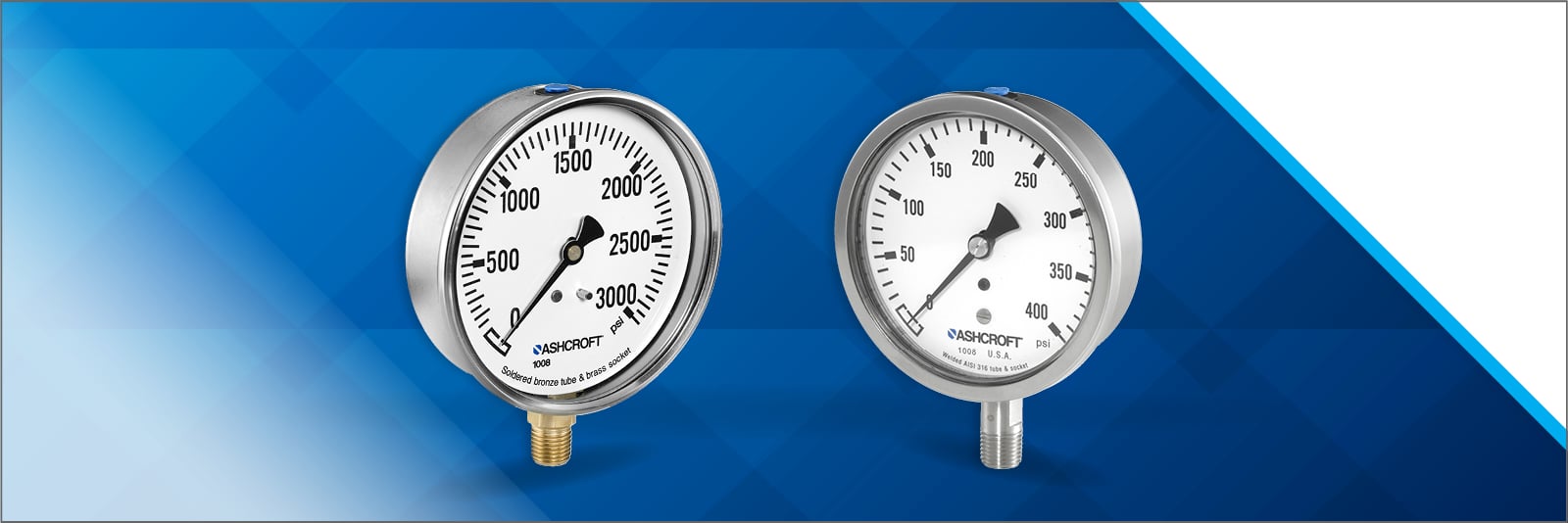
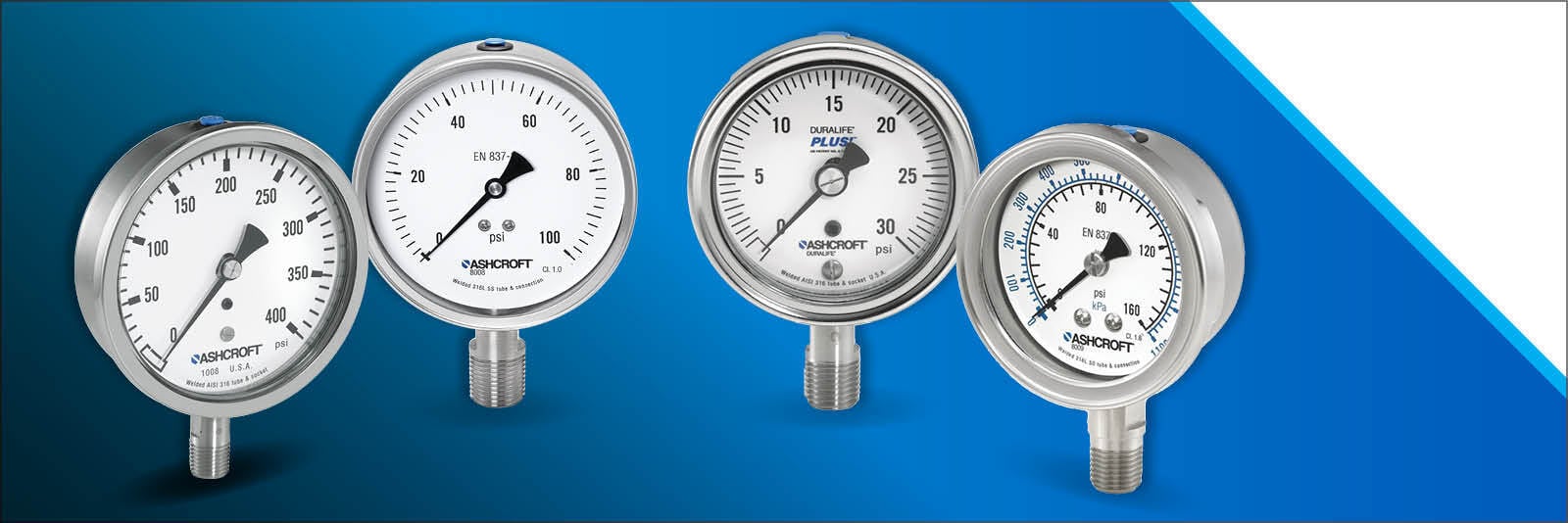
This article compares four industrial pressure gauges in 2.5" (63 mm), 3.5" and 4" (100 mm) dial sizes. First, for standard operating conditions and non-critical measurement points, we will compare the Ashcroft® 1008 and Ashcroft® 8008 Pressure Gauges, both providing a tamperproof design and reliable performance. For higher accuracy, harsh environments and applications requiring in-field inspection and recalibration, we compare the Ashcroft® 1009 and Ashcroft® 8009 models.
Read on to understand the key differences in construction, performance and application fit so you can confidently select the right instrument for your system.
What are the primary differences between the 1008/8008 and 1009/8009 pressure gauges?
The main difference is that the 1008 and 8008 are designed with a tamperproof case for general use, while the 1009 and 8009 are engineered for recalibration, inspection and higher accuracy in more demanding applications.
While these gauges share a common Bourdon tube design and industrial form factor, they differ significantly in materials, accuracy class, performance features and long-term reliability under harsh conditions.
How do pressure gauge movements differ in high-vibration and stable applications?
Pressure gauge performance is heavily influenced by movement design. Traditional gear-and-pinion mechanisms provide precise, responsive readings in stable systems, while vibration-resistant designs—such as Ashcroft’s Duralife® movement—are engineered to improve durability, stability and accuracy in harsh or pulsating environments.
1. Duralife® movement
Duralife® technology, which is used in the 1008 and 1009 models is designed to improve long-term performance in applications with vibration, pulsation or mechanical shock.
How it works:
-
Uses a floating movement design that allows for additional dampening, especially at low pressures
-
Incorporates low-friction components and flexible linkages instead of direct gear contact
Key advantages:
Reduced wear
- Minimizes metal-on-metal contact compared to traditional gear teeth
- Extends service life over time
Higher vibration resistance
- Performs well in pumps, compressors and rotating equipment
- Reduces pointer flutter
Improved long-term accuracy
- Calibration holds longer due to reduced component wear
Better shock resistance
- More robust construction helps withstand pressure spikes and mechanical shock
onsideration:Higher upfront cost compared to conventional movement
Consideration:
- Higher upfront cost compared to conventional movement
2. Conventional gear-and-pinion movement
Conventional gear-and-pinion movements in the 8008 and 8009 use direct mechanical linkage to translate pressure into pointer movement. This design is widely used due to its simplicity, precision and cost efficiency.
This option is best suited for stable pressure systems with minimal vibration or pulsation and applications where cost and serviceability are priorities.
Key advantages:
High initial precision
-
Direct mechanical translation provides crisp, responsive readings
-
Ideal for calibration benches, lab environments and stable process lines
Lower cost
- Simpler design reduces manufacturing cost
- Well suited for large-scale installations
Ease of service
-
Familiar design makes calibration, repair and replacement straightforward
Proven reliability
-
Long track record across industrial applications
Limitations in demanding environments:
-
More wear over time due to gear teeth being in constant contact
-
Sensitive to vibration, which can result in pointer flutter
-
Accuracy drift from harsh conditions causing performance to degrade
-
Shorter lifespan, especially in pumps, compressors and pulsation-heavy systems
When should you choose Duralife® vs. conventional movement?

How do internal dampening technologies improve pressure gauge performance?
Pressure gauges operating in vibrating or pulsating systems require internal dampening to stabilize pointer movement, reduce wear and maintain accuracy over time. Ashcroft offers the following options in for their 1008, 8008, 1009 and 8009 pressure gauges:
1.FlutterGuard™ (8008 and 8009)
FlutterGuard™ is one of Ashcroft’s internal dampening mechanism options designed to reduce pointer oscillation and protect internal components in moderate vibration environments.
How it works:
-
Uses a lighter silicone applied to gear components
-
Reduces flutter while maintaining responsiveness
2. PLUS!™ performance (1008 and 1009)
PLUS!™ Performance is another dampened movement option offered by Ashcroft that combines enhanced dampening with improved durability and long-term accuracy.
How it works:
-
Uses a thicker silicone contained around the pinion
-
Provides resistance to pressure fluctuations
Key benefits of internal dampening
-
Improved readability with a stable pointer
-
Reduced wear and longer lifespan
-
Better performance in pulsating systems
-
Eliminates need for liquid-filled gauges in many cases
-
Maintains responsiveness compared to heavy fill fluids
Key difference between FlutterGuard™ and PLUS!™ Performance:
-
FlutterGuard™ focuses on wear reduction and longevity
-
PLUS!™ performance focuses on stabilizing pressure fluctuations and improving accuracy
Features, benefits and common applications for the 1008 and 8008 pressure gauges
These gauges are designed to provide reliable performance in standard operating conditions where cost and durability are key considerations.
Key features and benefits:
-
Cost-effective for OEM and plant-wide use
-
Durable with internal dampening technologies
-
Wide pressure ranges
-
Tamperproof design
Typical applications:
-
Pumps and compressors
-
Hydraulics and pneumatics
-
Irrigation and utilities
-
General manufacturing
Features, benefits and common applications for the 1009 and 8009 pressure gauges
These gauges are higher-performance instruments designed for applications that require greater accuracy, durability and long-term stability.
Key features and benefits:
-
All-welded stainless steel construction
-
Higher accuracy (±1%)
-
PLUS!™ or FlutterGuard™ dampening
-
Removable bayonet ring (8009) for serviceability
Typical applications:
-
Hydrogen and alternative fuels
-
Oil & gas and chemical processing
-
High-vibration systems
-
OEM systems requiring precision
Ready to learn more?
Now that you understand the differences between these four industrial pressure gauges, you can make a more informed decision based on your application requirements.
If you have questions, explore the related resources below or contact us to speak with a product expert. You can also use our Pressure Gauge Selection Tool to find the best solution for your specific needs.

Topics: