

Subscribe now and get the latest blog posts delivered straight to your inbox.
Choosing the right low pressure diaphragm gauge requires more than selecting a pressure range. Factors such as media compatibility, process connections, overpressure protection, environmental conditions and application type can all influence long-term performance and reliability.
Whether you're monitoring vacuum, air, gas or industrial process pressure, selecting the appropriate gauge helps ensure accurate measurements and longer service life.
Read this article to learn the questions to consider when choosing a low-pressure diaphragm gauge and how to determine which design is best suited for your application.
When should you use a low-pressure diaphragm gauge?
Low-pressure diaphragm gauges are used when standard pressure gauges do not provide enough sensitivity to accurately measure low pressure, vacuum or compound pressure ranges.
Many applications operate at only a few inches of water column or a few psi. In these situations, a diaphragm sensing element provides greater sensitivity and improved readability compared to gauges designed for higher pressure measurement.
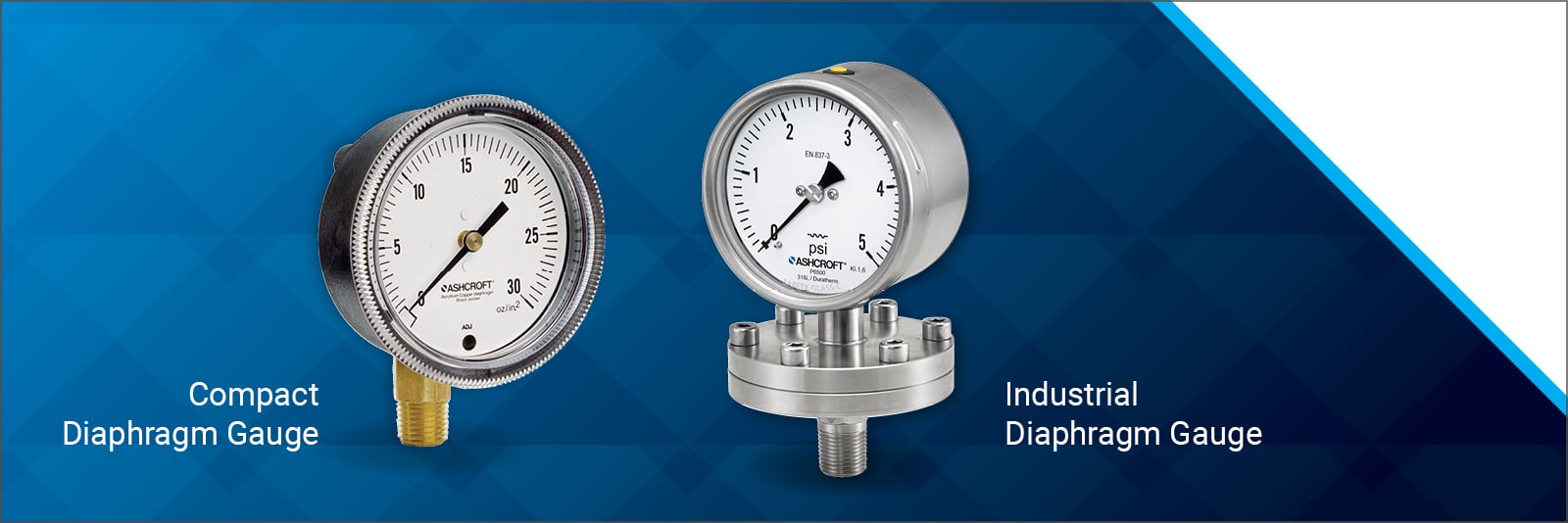
Two types of low-pressure diaphragm gauges
1. Compact, such as the Ashcroft® 1490 Low-Pressure Gauge are commonly used in air, gas, vacuum and OEM applications where space is limited and operating conditions are relatively clean. These gauges are often found on:
-
Vacuum pumps
-
Air compressors
-
Filters
-
Burners
-
Leak detection equipment
-
Vacuum ovens
-
Respirators
-
Specialized OEM equipment
2. Industrial, such as the Ashcroft® P5500 and P6500 Low-Pressure Diaphragm Gauge are designed for applications requiring greater durability, corrosion resistance and environmental protection. You can find these instruments in:
-
Chemical processing
-
Oil and gas
-
Food and beverage
-
Pulp and paper
-
Industrial vacuum systems
Which option to choose will depend on the pressure range of the application, media and operating environment.
What pressure range do you need?
Selecting the proper pressure range is one of the most important steps in choosing a low pressure diaphragm gauge. If the range is too large, small pressure changes may be difficult to see. If the range is too small, the gauge may be exposed to overpressure conditions that can affect performance and service life.
When evaluating pressure range, consider the following:
-
Normal operating pressure – The pressure the system runs at most of the time
-
Maximum system pressure – The highest pressure expected during normal operation
-
Potential pressure spikes – Temporary surges that could exceed the operating range
-
Vacuum requirements – Whether the application measures pressure below atmospheric pressure
-
Compound pressure requirements – Whether both pressure and vacuum need to be measured on the same gauge
-
Desired readability – The level of resolution needed to clearly identify pressure changes
The ideal range allows the normal operating pressure to fall within the middle portion of the scale while still accommodating occasional fluctuations.
How much overpressure protection do you need?
Overpressure protection helps prevent damage when system pressure temporarily exceeds the gauge's normal operating range. This is particularly important in low-pressure applications because even modest pressure spikes can represent a significant percentage of full scale.
Applications that experience startup surges, process upsets or pressure fluctuations may benefit from enhanced overpressure protection. Industrial gauges for example, can be configured with optional overpressure protection up to 10 times full scale. Compact gauges, on the other hand, offer standard proof pressure.
What media will the gauge measure?
The process media determines which wetted materials are appropriate for the application. Selecting compatible wetted materials helps improve reliability, accuracy and service life.
For clean air and gas applications, a compact gauge may be sufficient. For example, the Ashcroft® 1490 is commonly used in air, gas and vacuum systems. However, if you applications involve corrosive or aggressive media, stainless steel or Hastelloy® wetted materials may be required. The Ashcroft® P5500 and P6500 offer these material options to support more demanding environments.
To ensure media compatibility between your instrument and your process, refer to Ashcroft's material selection and corrosion guide.
What process connection is required?
The process connection should match both the installation requirements and operating conditions of the application. Common options include:
-
NPT threaded connections – Standard threaded connections for piping systems
-
Hose barb connections – Designed for flexible tubing and low-pressure hose applications
-
Tubing connections – Used with rigid or semi-rigid tubing systems
-
Flanged connections – Preferred for larger process lines and industrial installations
Compact gauges often provide multiple connection styles for OEM and panel-mounted equipment, while industrial process gauges may offer larger threaded and flanged connections for piping systems.
Also consider the connection location. Common configurations include lower mount, center back mount, top mount and side mount.
Will vibration or pulsation affect the reading?
Vibration and pulsation can make low-pressure readings difficult to interpret and may increase wear on internal gauge components. Applications involving pumps, compressors or regulators often benefit from dampening technologies that help stabilize pointer movement and improve readability. Reducing pointer flutter not only improves visibility but can also help extend instrument life.
Will the gauge be exposed to harsh environmental conditions?
Environmental conditions can have a significant impact on gauge performance and longevity.
When evaluating an application, consider:
-
Outdoor exposure – Sunlight, rain and weather conditions
-
Humidity – Moisture that may affect long-term performance
-
Washdown requirements – Frequent cleaning with water or cleaning solutions
-
Ambient temperature – The temperature surrounding the instrument
-
Process temperature – The temperature of the media being measured
-
Corrosive atmospheres – Airborne chemicals, salt spray or other contaminants that may affect materials
A compact gauge may be sufficient for indoor OEM applications, while an industrial gauge may be preferred for environments where stainless steel construction and higher levels of environmental protection are needed.
NOTE: If the gauge will be installed in areas where flammable gases, vapors or combustible dusts are present, hazardous location approvals may be required. This includes applications in oil and gas, petrochemical processing and chemical manufacturing. Learn more about hazardous locations.
Which low pressure diaphragm gauge is the right fit for your application?
While both are low pressure diaphragm gauges, they are designed for different operating environments and performance requirements.
Figure 1: Low-pressure diaphragm gauge comparison chart
| Feature | Ashcroft® 1490 | Ashcroft® P5500/P6500 |
| Primary Use | Air, gas, vacuum and OEM applications | Industrial process applications |
| Accuracy | ±2-1-2% of span | ±1.6% of span |
| Pressure Range | Vacuum, compound and pressure to 15 psi | 10 in. H₂O through 300 psi |
| Wetted Materials | Beryllium copper and brass | Stainless steel and Hastelloy® options |
| Process Connections | NPT, tubing and hose barb | Threaded and flanged |
| Overpressure Protection | Standard proof pressure | Optional 5x or 10x protection |
| Hazardous Location Option | No | Optional ATEX certification |
Ready to learn more?
Now that you know what to look for when choosing a low-pressure diaphragm gauge, you can make a more informed decision based on your application requirements.
If you have questions, contact us to speak with a product expert or explore the related resources below. In the meantime, check out our pressure gauge selection tool that will guide you through the process of selecting the right gauge for your needs.

Topics: