

Subscribe now and get the latest blog posts delivered straight to your inbox.

Protecting a pressure measurement assembly from high process temperatures requires looking beyond the instrument itself. The process media, diaphragm seal, fill fluid, connections and heat dissipation accessories all affect how the assembly performs.
Metal processing, glass and ceramic manufacturing and chemical processing often involve elevated temperatures during casting, heat treatment, distillation, kilning and drying. Pressure instruments may be installed at inlet and outlet locations on furnaces, boilers, heat exchangers and pump systems.
Although mechanical pressure gauges are a common example, many of the same protection considerations apply to pressure transmitters, transducers and switches used with diaphragm seals.
Ashcroft works with customers to select pressure measurement assemblies for demanding process conditions.
Read this article to learn:
- Temperature effects: How excessive heat can damage instruments and affect readings.
- Instrument selection: Why construction and temperature limits matter.
- Process media: How steam, corrosive fluids and materials that must remain hot change the approach.
- Assembly components: What to check in seals, connections and fill fluids.
- Measurement accuracy: How to manage heat dissipation and fill-fluid expansion.
1. What happens when a pressure instrument is exposed to high process temperatures?
Excessive process heat can affect measurement accuracy, damage instrument components and shorten service life. The effects depend on the instrument construction, operating conditions and exposure time.
Common effects of excessive heat include:
- Measurement errors: Elevated temperatures can affect sensing elements and other components, causing indicated pressure to shift.
- Seal deterioration: Heat can damage gaskets and O-rings, potentially causing leaks.
- Case-fill changes: High temperatures can affect glycerin or silicone liquid fills, leading to discoloration or leakage.
- Instrument damage: Prolonged heat exposure can permanently damage internal components.
Figure 1. Temperature limitations of diaphragm seal assembly components

What is temperature error?
ASME describes temperature error as a change in pressure indication caused by gauge components operating at a temperature different from the temperature at which the gauge was calibrated.
Check allowable process and ambient temperatures before choosing the assembly. For more detail, see How Does Temperature Affect Pressure Gauge Performance?.
2. What type of instrument should you use for high-temperature processes?
Choose a pressure instrument designed for the operating conditions, then determine what protection it needs from process heat. For mechanical pressure gauges, a heavy-duty solid-front process design is recommended over gauges designed for general industrial or commercial use.
For example, consider a 4.5-inch process gauge or comparable 100 mm option where applicable. These sizes are often associated with heavy-duty process gauge construction, but dial size alone does not establish temperature suitability.
Important selection considerations include:
- Solid-front case: Provides a barrier between the sensing element and the operator and directs pressure relief toward the rear if the sensing element ruptures.
- Robust construction: Supports demanding process service, including pressure fluctuations and other operating stresses.
- Suitable accuracy: Consider ASME Grade 2A accuracy when the measurement requirements call for it.
- Temperature compatibility: Check the instrument's own ratings even when a diaphragm seal or heat dissipator is used.
The Ashcroft® 1279 turret-style process gauge and Ashcroft® 1209 welded stainless steel case gauge are two examples.
Pressure transmitters, transducers and switches can also be paired with diaphragm seals, but their own temperature limits and construction requirements must be checked. A rugged instrument alone does not eliminate the need for heat protection.
3. How does the process media affect your instrument assembly?
The process media determines whether a condensate barrier is sufficient or whether the instrument needs to be isolated from the process. Steam, corrosive media and materials that must remain hot can require different protection methods.
| Process media | Primary concern | Protection to consider |
|---|---|---|
| Steam | Direct exposure to high process temperatures | A properly primed coil or pigtail siphon, with additional stand-off piping if needed |
| Corrosive or particulate-laden media | Corrosion, instrument damage or clogging | A compatible diaphragm seal that isolates the instrument from the process |
| Media that must remain hot | Cooling can cause thickening, solidification or clogging | A diaphragm seal with suitable temperature-rated components |
Table 1. Common process media challenges and pressure instrument protection options
A properly primed siphon uses condensate to help protect an instrument in steam service. For media that could corrode, clog or otherwise damage the instrument, a diaphragm seal isolates the instrument from direct contact with the process.
The appropriate solution depends on the process temperature, media characteristics and operating conditions.
For a closer look at siphon types and their applications, see What Is a Siphon?.
4. How do you select assembly components that can withstand high temperatures?
Check the temperature and pressure limits of the complete assembly, not only the instrument or diaphragm seal. Gaskets, connections, fill fluids and other components can set the practical limit for the installation.
Three important considerations include:
- Diaphragm seal construction: All-welded metallic designs can avoid elastomeric gaskets that may limit operating temperature and create potential leak paths.
- Connections: Threaded joints may rely on PTFE tape or other sealants with temperature limits. Where appropriate, welded connections avoid relying on those materials.
- Fill fluid: The fluid transferring pressure from the diaphragm to the instrument must be suitable for the expected temperature. The thin metallic diaphragm does not, by itself, prevent heat transfer into the fill fluid.
Material compatibility, pressure rating and temperature limits should be checked together.
The illustration below shows two examples of pressure measurement assemblies configured for extreme temperatures, including instrument construction, fill fluids, heat dissipation accessories and diaphragm seals.
Figure 2. Examples of pressure measurement assemblies configured for extreme process temperatures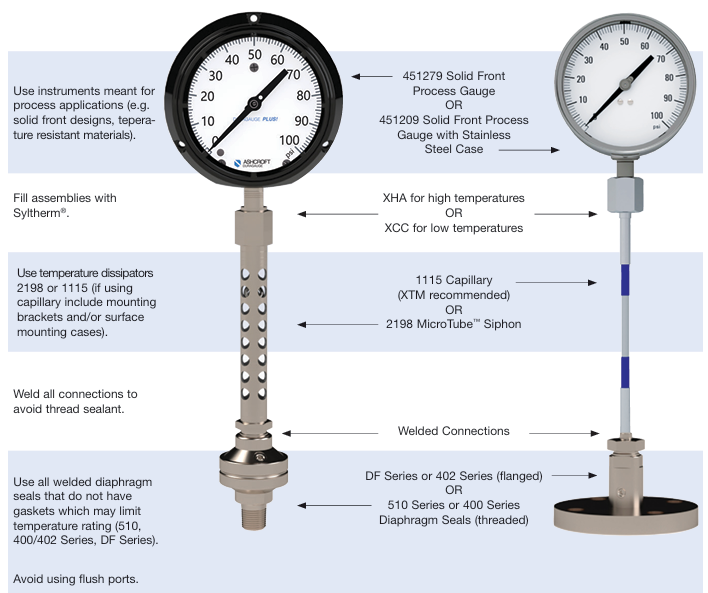
The maximum allowable temperature of an assembly depends on its individual components. For a more detailed breakdown of temperature limitations and recommended configurations, refer to Ashcroft's Min/Max Temperature Guide.
For additional diaphragm seal selection guidance, see How Do I Safely Select Diaphragm Seals for High-Temperature Applications?.
5. How can you protect measurement accuracy when adding temperature protection?
Dissipate heat efficiently while keeping diaphragm seal fill-fluid volume as low as practical. Heat can expand the sealed fill fluid and create a change in indicated pressure that does not reflect actual process pressure.
When a diaphragm seal alone does not provide enough separation from the heat, a dissipation device may be needed between the seal and the instrument.
Two examples include:
- Ashcroft® 2098/2198 MicroTube™ siphons: Designed to dissipate heat while limiting internal fill-fluid volume.
- Ashcroft® 1115 Series capillary: Provides distance between the hot process and the instrument so heat can dissipate along the line.
More distance can improve cooling, but adding unnecessary fill-fluid volume can increase temperature-related measurement error. The right configuration balances heat reduction with measurement performance.
For a more detailed discussion of accessory options, see Heat Dissipation Pressure Gauge Accessories for Non-Steam Applications.
Ready to learn more?
High-temperature applications can place different demands on the instrument, diaphragm seal and connected accessories. Protecting the complete assembly requires understanding the process conditions and selecting components that work together.
Ashcroft'sCritical Application Solution Experts® (CASE®) can help you evaluate operating conditions and select a suitable assembly. For additional technical guidance, review the related resources below or contact Ashcroft with your application questions.